Item
This page describes the data sources and filters that are available to you when exporting item and variation data via catalogues. It is purely meant to serve as a reference and assumes that you already have a basic understanding of catalogues.
Format type: Item (new)
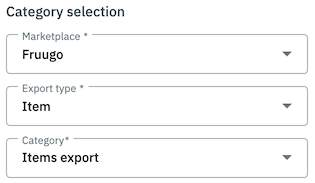
The export type described on this page is found in the menu Data & Plugins » Catalogues. When creating a new catalogue, first select the marketplace format you want to use from the upper drop-down list. Then you can select the format type Item from the middle drop-down list.
|
Item and Item (New)
Item is an old export type that has been replaced by the export type Item (New) for most sales channels. These two export types use different data sources and are not to be confused with each other. |
1. Data sources
This chapter contains a list of all item data sources that can be exported via the catalogue tool.
1.1. Variation
| Field | Explanation | ||||||
|---|---|---|---|---|---|---|---|
Variation ID |
The ID of the variation. |
||||||
Is main variation |
Indicates whether the variation is a main variation.
|
||||||
ID of main variation |
Specifies the ID of the corresponding main variation. Note: For main variations this field is empty. |
||||||
Position |
The variation’s position number. Corresponds to the option in the menu: Item » Edit item » [Open variation] » Tab: Settings » Area: Basic settings » Entry field: Position Variations can be sorted by their position number in the back end and front end. Back end: Search for items in the menu Item » Edit items. Move your mouse cursor over the column header Position. Click on the small triangle () to display the items in ascending or descending order by their position number. Front end: Select the appropriate sorting option in the plentyShop LTS assistant. Note: Open the plentyShop LTS assistant and navigate to Pagination and sorting » Additional sorting options. If the option Calculate the variation position based on monthly sales is set to Yes, then manually entered position numbers will be overwritten. |
||||||
Active |
Specifies whether the variation is activated.
Corresponds with settings in the Item » Items » [Open variation] » Tab: General » Availability and visibility » Option: Active menu Background info: Variations only become visible in the plentyShop or on marketplaces once they have been activated. In other words, you can work on inactive variations without your customers noticing. |
||||||
Show unit price |
Specifies whether the unit price is displayed in the online store.
Corresponds with the settings in the menu: Item » Items » [Open variation] » Tab: Product details » Section: Dimensions and content » Option: Show unit price Background info: The unit price tells you how much the item costs per pound, litre or other unit of measure. It’s calculated based on the item’s unit, content and price. The unit price allows consumers to compare prices. In some countries, the unit price must be specified for products that are sold by weight, volume, length or surface area. |
||||||
Variation number |
The variation’s number. Corresponds to the option in the menu: Item » Edit item » [Open variation] » Tab: Settings » Area: Basic settings » Entry field: Variation No. |
||||||
Model |
The variation’s model name. Corresponds to the option in the menu: Item » Edit item » [Open variation] » Tab: Settings » Area: Basic settings » Entry field: Model |
||||||
External variation ID |
The external variation ID. Corresponds to the option in the menu: Item » Edit item » [Open variation] » Tab: Settings » Area: Basic settings » Entry field: External Variation ID Use case: The external variation number facilitates importing items and variations from an external system. |
||||||
Net purchase price |
The net purchase price. Corresponds to the option in the menu: Item » Edit item » [Open variation] » Tab: Settings » Area: Costs » Entry field: Net purchase price Note: The purchase price is either calculated automatically or managed manually depending on how the settings were saved in the menu Setup » Stock » Stock » Incoming items. Item bundles: the net purchase price can automatically be calculated based on the bundle components. |
||||||
Order picking |
The type of picking.
Corresponds with the option in the : Item » Items » [Open variation] » Tab: Shipping » Drop-down list: Order picking menu |
||||||
Stock limitation |
Specifies which stock limitation setting the variation has.
Corresponds with settings in the Item » Items » [Open variation] » Tab: General » Section: Availability and Visibility » Drop-down list: Stock limitation menu |
||||||
Store: visible if net stock is positive |
Specifies whether the variation is automatically visible in the plentyShop when the net stock is positive. Note: Both client visibility automatics complement each other and only apply if the option stock limitation is set to To net stock. Relationship to other settings: Both client visibility automatics have priority over list automatic visibility. We recommend that you either control the visibility with the “client” option or the “list” option. They should not be combined.
|
||||||
Store: invisible if net stock is 0 or negative |
Specifies whether the variation is automatically invisible if it is out of stock. Note: Both client visibility automatics complement each other and only apply if the option stock limitation is set to To net stock. Relationship to other settings: Both client visibility automatics have priority over list automatic visibility. We recommend that you either control the visibility with the “client” option or the “list” option. They should not be combined.
|
||||||
Available if net stock is positive |
Specifies whether the variation is automatically available and purchasable in the plentyShop when it is in stock. Note: Both client availability automatics complement each other and only apply if the option stock limitation is set to To net stock.
|
||||||
Not available if net stock is 0 or negative |
Specifies whether the variation is automatically unavailable when it is out of stock. Note: Both client availability automatics complement each other and only apply if the option stock limitation is set to To net stock.
|
||||||
Max. order quantity |
Specifies the maximum quantity that is permitted per order. Corresponds with settings in the Item » Items » [Open variation] » Tab: General » Section: Settings » Field: Maximum order quantity menu Note: Decimal values are possible, e.g. allowing customers to order products by weight or length. Note: You can use the maximum order quantity in combination with pre-orders, for example to prevent competitors from completely buying out the variation at a reduced price. |
||||||
Min. order quantity |
Specifies the minimum quantity that is permitted per order. Corresponds with settings in the Item » Items » [Open variation] » Tab: General » Section: Settings » Field: Minimum order quantity menu Note: Decimal values are possible, e.g. allowing customers to order products by weight or length. |
||||||
Interval order quantity |
Specifies which quantity intervals the variation can be ordered in. Corresponds with settings in the Item » Items » [Open variation] » Tab: General » Section: Settings » Field: Interval order quantity menu Note: Decimal values are possible, e.g. allowing customers to order products by weight or length. |
||||||
Available until |
Specifies the last date when the variation is available.
The date is exported in the following format: Example: Corresponds with settings in the Item » Items » [Open variation] » Tab: General » Section: Availability and Visibility » Field: Available until menu |
||||||
Release date |
Specifies the date when the variation becomes available.
The date is exported in the following format: Example: Corresponds with settings in the Item » Items » [Open variation] » Tab: General » Section: Settings » Field: Release date menu Note: The variation can be visible in the plentyShop before this date, e.g. for preorders. |
||||||
Variation name |
The name of the variation. Corresponds to the option in the menu: Item » Edit item » [Open variation] » Tab: Settings » Area: Basic settings » Entry field: Variation name |
||||||
Gross weight g |
The variation’s gross weight in grams. Corresponds with the settings in the menu: Item » Items » [Open variation] » Tab: Product details » Section: Dimensions and content » Field: Gross weight in grams Background info: For individually packaged variations, the gross weight is the weight of the variation including packaging. The value is used to calculate shipping packages and weight-based shipping costs. Item bundles: The gross weight can automatically be calculated based on the bundle components. |
||||||
Net weight g |
The variation’s net weight in grams. Corresponds with the settings in the menu: Item » Items » [Open variation] » Tab: Product details » Section: Dimensions and content » Net weight in grams Background info: The net weight is the weight of the variation without packaging. Item bundles: The gross weight can automatically be calculated based on the bundle components. |
||||||
Width mm |
The variation’s dimensions in millimetres. Corresponds with the settings in the menu: Item » Items » [Open variation] » Tab: Product details » Section: Dimensions and content » Field: Height/Length/Width |
||||||
Length mm |
The variation’s dimensions in millimetres. Corresponds with the settings in the menu: Item » Items » [Open variation] » Tab: Product details » Section: Dimensions and content » Field: Height/Length/Width |
||||||
Height mm |
The variation’s dimensions in millimetres. Corresponds with the settings in the menu: Item » Items » [Open variation] » Tab: Product details » Section: Dimensions and content » Field: Height/Length/Width |
||||||
Extra shipping charge 1; |
The extra shipping charge, i.e. a fee that is charged in addition to the normal shipping costs. Extra shipping charges are useful for large or bulky items that are particularly expensive to ship.
Corresponds with the option in the : Item » Items » [Open variation] » Tab: Shipping » Field Extra shipping charge 1 or 2 menu Additional settings: In each of your shipping profiles, specify whether these extra charges should be added to the basic shipping costs. Note: The manual also includes several example calculations for extra shipping charges. |
||||||
Units contained |
Units contained describes several sales units combined in one package. Corresponds with the settings in the menu: Item » Items » [Open variation] » Tab: Product details » Section: Dimensions and content » Field: Units contained Note: This value does not influence how the unit price is calculated. |
||||||
Quantity of packing units |
Specifies the number of packing units if the item consists of multiple packages. Corresponds with the option in the : Item » Items » [Open variation] » Tab: Shipping » Field: Packing quantity menu Note: The value 0 means that an item should always be shipped in a single package, regardless of the quantity. This setting also applies to various items. This means that all items of an order that have the value 0 will be packed into one package. |
||||||
Net transportation costs |
The net transportation costs for the variation. Corresponds with the option in the : Item » Items » [Open variation] » Tab: Pricing » Section: Costs » Transportation costs menu Note: This value is used for price calculations and for calculating the acquisition price. |
||||||
Net storage costs |
The net storage costs for the variation. Corresponds with the option in the : Item » Items » [Open variation] » Tab: Pricing » Section: Costs » Storage costs menu |
||||||
Customs |
The customs value saved for the variation as a percentage. Corresponds with the option in the : Item » Items » [Open variation] » Tab: Pricing » Section: Costs » Customs in % menu |
||||||
Customs tariff number |
The variation’s customs tariff number. Corresponds with the option in the : Item » Items » [Open variation] » Tab: Pricing » Section: Costs » Customs tariff number menu Note: In PlentyONE, it’s possible to save a different customs tariff number for each variation. Example: In some countries, children’s clothing is taxed differently depending on the size. In this case, it makes sense to save the customs tariff number separately for each variation. Inheritance: The customs tariff number is automatically passed down from the main variation to the sub-variations. This means:
|
||||||
Operating costs |
The operating costs saved for the variation as a percentage. Corresponds with the option in the : Item » Items » [Open variation] » Tab: Pricing » Section: Costs » Operating costs in % menu |
||||||
Invisible: in item list |
Specifies whether the variation is unlisted. Unlisted items do not appear in categories, search results, store specials, cross-selling lists and lists of last seen items. They are only accessible via a direct URL. Relationship to other settings: Both client visibility automatics have priority over the list visibility automatics. We recommend that you either control the visibility with the “client” option or the “list” option. They should not be combined.
Corresponds with settings in the Item » Items » [Open variation] » Tab: General » Section: Availability and Visibility » Option: List automatic visibility: Always invisible in item list menu |
||||||
Default shipping costs |
The shipping costs that are calculated once per day. |
||||||
VAT rate |
The variation’s VAT rate. Is specified by a number that represents VAT rate A, B, C, D, E or F. You can find the VAT rates in the menu Setup » Client » [Select client] » Locations » [Select location] » Accounting » Tab: VAT rates » [Open configuration].
Corresponds to the option in the menu: Item » Items » [Open variation] » Element: Costs » Drop-down list: VAT |
||||||
Availability |
The displayed delivery time of the item. Corresponds to the option in the menu: Item » Items » [Open variation] » Tab: General » Section: Availability and visibility » Field: Displayed delivery time |
||||||
Content unit |
The unit of the variation. Is specified by the unit’s ISO code. You can find a list of ISO codes here. Alternatively, you can find the ISO codes in the menu Setup » Item » Units. Corresponds with the settings in the menu: Item » Items » [Open variation] » Tab: Product details » Section: Dimensions and content » Drop-down list: Unit Note: Use this export field together with Content value. |
||||||
Content value |
Specifies the variation’s numerical content. Corresponds with the settings in the menu: Item » Items » [Open variation] » Tab: Product details » Section: Dimensions and content » Field: Quantity Note: Use this export field together with Content unit ISO or Content unit name. |
1.2. Attribute
Folder level
The subfolders in this folder correspond to the different attributes you have set up in the Setup » Item » Attributes menu of your system. Open the folder of whichever attribute has information that you want to export.
Data source level
| Field | Explanation |
|---|---|
Attribute ID |
The attribute that’s linked to the variation. For example “Colour” or “Size”. Is specified by the attribute ID. You can find the attribute IDs in the menu Setup » Item » Attributes. |
Attribute name |
The attribute that’s linked to the variation. For example “Colour” or “Size”. Is specified by the internal attribute name. You can find the internal attribute names in the menu Setup » Item » Attributes. |
Value ID |
The attribute value that’s linked to the variation. For example “blue”, “red” or “green”. Is specified by the attribute value ID. You can find the attribute value IDs in the menu Setup » Item » Attributes » [Open attribute] » Tab: Values. |
Value name |
The attribute value that’s linked to the variation. For example “blue”, “red” or “green”. Is specified by the internal attribute value name. You can find the internal attribute value names in the menu Setup » Item » Attributes » [Open attribute] » Tab: Values. |
1.3. Barcode
Here you’ll see a list of the barcode types that you’ve already configured in the menu Setup » Item » Barcode. When you add a barcode type to the catalogue, the actual code that was saved for this barcode type in the variation data record will be exported.
Corresponds to the option in the menu: Item » Items » [Open variation] » Element: Barcodes » Column: Code
1.4. Sales price
Here you’ll see a list of the sales price types that you have already configured in the menu Setup » Item » Sales Price. When you add a sales price type to the catalogue, the actual price that was saved for this sales price type in the variation data record will be exported.
Corresponds to the option in the menu: Item » Items » [Open variation] » Element: Sales prices.
1.5. Property (variation)
Folder level
The folders here correspond to the various property groups that you’ve already created in the menu Setup » Settings » Properties » Groups. Open a group’s folder and then add whichever properties have values that you want to export.
Data source level
The data sources here correspond to the various properties that you’ve already created in the menu Setup » Settings » Properties » Configuration. Add whichever properties have values that you want to export. The value that is saved for the property in the variation data record will be exported. Specifically, that means:
| Property type | Explanation |
|---|---|
None; |
Since no value is entered into the menu Item » Items » [Open variation] » Properties, no value is exported to the marketplace. This means: It is currently not possible to differentiate between variations that are linked to this type of property and variations that are not linked to this type of property. This is a known issue and will be fixed in the future. |
Date; |
The value saved in the menu Item » Items » [Open variation] » Properties » Column: Value will be exported. |
HTML; |
The text saved in the menu Item » Items » [Open variation] » Properties will be exported. Note: Texts can be saved in multiple languages. Use the drop-down list to specify which language version of the text you want to export. If you want to export the text in multiple languages, then you need to add the data source multiple times. |
Multi selection |
If you export a file in CSV or TXT format, then you will only see the word "Array" instead of the actual export values. This means: It is currently not possible to determine which selection values were linked to the variation. This is a known issue and will be fixed in the future. Possible workaround 1: You can download a JSON or XML file instead. With these file types, you can see which selection values were linked to the variation.
Possible workaround 2: Export the data with the tools FormatDesigner or Elastic Export instead. |
1.6. SKU
| Field | Explanation |
|---|---|
SKU |
Select the order referrer from the drop-down list. Enter the account if needed. Corresponds to the option in the menu: Item » Items » [Open variation] » Element: SKU Note: Not every marketplace has an account. In such cases, enter 0 as the account ID. |
Parent SKU |
Select the order referrer from the drop-down list. Enter the account if needed. Corresponds to the option in the menu: Item » Items » [Open variation] » Element: SKU Note: Not every marketplace has an account. In such cases, enter 0 as the account ID. |
|
What is the difference between SKU and parent SKU?
The parent SKU is only needed if you are using item variations.
For items with no variations only the SKU is needed. |
1.7. Item
| Field | Explanation |
|---|---|
Item ID |
The item’s ID. The item ID is a unique, consecutive number that is used to identify each item in PlentyONE. |
Manufacturer ID |
The manufacturer of the item. Is specified by the manufacturer ID. You can find the manufacturer IDs in the menu Setup » Item » Manufacturers. Corresponds to the option in the menu: Item » Edit item » [Open item] » Tab: Global » Area: Basic settings » Drop-down list: Manufacturer |
Manufacturer country ISO-Code |
The country where the item was manufactured. Is specified by the country ISO code. You can find a list of country ISO codes here. Corresponds to the option in the menu: Item » Edit item » [Open item] » Tab: Global » Area: Basic settings » Drop-down list: Manufacturing country |
Manufacturer country ID |
The country where the item was manufactured. Is specified by the country ID. You can find a list of country IDs here. Corresponds to the option in the menu: Item » Edit item » [Open item] » Tab: Global » Area: Basic settings » Drop-down list: Manufacturing country |
Manufacturer Country name |
The country where the item was manufactured. Is specified by the country name. You can find a list of country names here. Corresponds to the option in the menu: Item » Edit item » [Open item] » Tab: Global » Area: Basic settings » Drop-down list: Manufacturing country |
EU Responsible name |
The name of the EU-responsible person of the manufacturer. This can be a natural or legal person. Corresponds to the option in the menu: Setup » Item » Manufacturers » [Open manufacturer] » Entry field: EU Responsible Name Note:
|
Contact Form |
The contact form of the manufacturer. Corresponds to the option in the menu: Setup » Item » Manufacturers » Open manufacture » Entry field: Contact form |
EU Responsible street |
The street name of the manufacturer’s EU-responsible person. Corresponds to the option in the menu: Setup » Item » Manufacturers » [Open manufacturer] » Entry field: EU Responsible Street Note:
|
EU Responsible house no |
The house number of the manufacturer’s EU-responsible person. Corresponds to the option in the menu: Setup » Item » Manufacturers » [Open manufacturer] » Entry field: EU Responsible House No. Note:
|
EU Responsible postal code |
The postcode of the manufacturer’s EU-responsible person. Corresponds to the option in the menu: Setup » Item » Manufacturers » [Open manufacturer] » Entry field: EU Responsible Postcode Note:
|
EU Responsible town |
The town of the manufacturer’s EU-responsible person. Corresponds to the option in the menu: Setup » Item » Manufacturers » [Open manufacturer] » Entry field: EU Responsible Town Note:
|
EU Responsible Country Id |
The internal country ID of the manufacturer’s EU-responsible person. In other words, the PlentyONE ID for the country. Corresponds to the option in the menu: Setup » Item » Manufacturers » [Open manufacturer] » Entry field: EU Responsible Country Note:
|
EU Responsible Country name |
The country of the manufacturer’s EU-responsible person. Is specified by the country name. You can find a list of country names here. Corresponds to the option in the menu: Setup » Item » Manufacturers » [Open manufacturer] » Entry field: EU Responsible Country Note:
|
EU Responsible Country ISO-Code |
The country of the manufacturer’s EU-responsible person. Is specified by the country ISO code. You can find a list of country ISO codes here. Corresponds to the option in the menu: Setup » Item » Manufacturers » [Open manufacturer] » Entry field: EU Responsible Country Note:
|
EU Responsible Email |
The email address of the manufacturer’s EU-responsible person. Corresponds to the option in the menu: Setup » Item » Manufacturers » [Open manufacturer] » Entry field: EU Responsible Email Note:
|
EU Responsible Contact form |
The contact form of the manufacturer’s EU-responsible person. Corresponds to the option in the menu: Setup » Item » Manufacturers » Open manufacture » Entry field: Postcode Note:
|
EU Responsible Phone number |
The telephone number of the manufacturer’s EU-responsible person. Corresponds to the option in the menu: Setup » Item » Manufacturers » [Open manufacturer] » Entry field: EU Responsible Phone number Note:
|
Manufacturer street |
The street of the manufacturer. Corresponds to the option in the menu: Setup » Item » Manufacturers » [Open manufacturer] » Field: Street |
Manufacturer house no. |
The house no. of the manufacturer. Corresponds to the option in the menu: Setup » Item » Manufacturers » [Open manufacturer] » Field: House No. |
Manufacturer postal code |
The postal code of the manufacturer. Corresponds to the option in the menu: Setup » Item » Manufacturers » [Open manufacturer] » Field: Postcode |
Manufacturer town |
The town of the manufacturer. Corresponds to the option in the menu: Setup » Item » Manufacturers » [Open manufacturer] » Field: Town |
Manufacturer phone number |
The phone number of the manufacturer. Corresponds to the option in the menu: Setup » Item » Manufacturers » [Open manufacturer] » Field: Telephone number |
Manufacturer name |
The name of the manufacturer. Corresponds to the option in the menu: Setup » Item » Manufacturers » [Open manufacturer] » Field: Name The manufacturer of the item. Is specified by the manufacturer name. You can find the manufacturer names in the menu Setup » Item » Manufacturers. Corresponds to the option in the menu: Item » Edit item » [Open item] » Tab: Global » Area: Basic settings » Drop-down list: Manufacturer |
Manufacturer legal name |
The legal name of the manufacturer. Corresponds to the option in the menu: Setup » Item » Manufacturers » [Open manufacturer] » Field: Legal Name |
Manufacturer email |
The e-mail address of the manufacturer. Corresponds to the option in the menu: Setup » Item » Manufacturers » [Open manufacturer] » Field: Email |
External manufacturer name |
The manufacturer of the item. Is specified by the external manufacturer name. You can find the external manufacturer names in the menu Setup » Item » Manufacturers. Corresponds to the option in the menu: Item » Edit item » [Open item] » Tab: Global » Area: Basic settings » Drop-down list: Manufacturer |
Producing country ID |
The country where the item was manufactured. Is specified by the country ID. You can find a list of country IDs here. Corresponds to the option in the menu: Item » Edit item » [Open item] » Tab: Global » Area: Basic settings » Drop-down list: Manufacturing country |
Producing country name |
The country where the item was manufactured. Is specified by the country name. You can find a list of country names here. Corresponds to the option in the menu: Item » Edit item » [Open item] » Tab: Global » Area: Basic settings » Drop-down list: Manufacturing country |
1.8. Stock
Stock levels can be managed for every warehouse separately. The data sources here correspond to the various warehouses that you’ve already configured in the menu Setup » Stock » Warehouse. Add the data source of the warehouse(s) whose stock you want to export.
|
What is the “Virtual warehouse”?
This data source returns the sum of the available stock in all warehouses. Example:
|
1.9. Item text
This folder contains data sources for the different item texts saved to each item in the Item » Items » [Open item] » Tab: Description menu.
| Field | Explanation |
|---|---|
Name 1 |
The item’s name 1. This is the item’s default name, which is used in the plentyShop and on marketplaces. Corresponds to the option in the menu: Item » Edit item » [Open item] » Tab: Texts » Entry field: Name 1 Once you’ve added this data field, you can use the drop-down list to specify which language version of the text should be exported. |
Name 2 |
The item’s name 2. This is an alternative item name that can be used for example for markets. Corresponds to the option in the menu: Item » Edit item » [Open item] » Tab: Texts » Entry field: Name 2 Once you’ve added this data field, you can use the drop-down list to specify which language version of the text should be exported. |
Name 3 |
The item’s name 3. This is an alternative item name that can be used for example for markets. Corresponds to the option in the menu: Item » Edit item » [Open item] » Tab: Texts » Entry field: Name 3 Once you’ve added this data field, you can use the drop-down list to specify which language version of the text should be exported. |
Preview text |
The item’s preview text. Corresponds to the option in the menu: Item » Edit item » [Open item] » Tab: Texts » Entry field: Preview text Once you’ve added this data field, you can use the drop-down list to specify which language version of the text should be exported. Note: The preview text is a short text which can be displayed in item lists. |
Meta description |
The item’s meta description. Corresponds to the option in the menu: Item » Edit item » [Open item] » Tab: Texts » Entry field: Meta description Once you’ve added this data field, you can use the drop-down list to specify which language version of the text should be exported. Note: The meta description makes it easier for search engines to find the item. |
Meta keywords |
The item’s meta keywords. Corresponds to the option in the menu: Item » Edit item » [Open item] » Tab: Texts » Entry field: Meta keywords Once you’ve added this data field, you can use the drop-down list to specify which language version of the text should be exported. Note: The meta keywords make it easier for search engines to find the item. |
Item text |
The item text is a detailed description, which is displayed in the item layout in the plentyShop. Corresponds to the option in the menu: Item » Edit item » [Open item] » Tab: Texts » Entry field: Item text Once you’ve added this data field, you can use the drop-down list to specify which language version of the text should be exported. |
Technical data |
The item’s technical data. Corresponds to the option in the menu: Item » Edit item » [Open item] » Tab: Texts » Entry field: Technical data Once you’ve added this data field, you can use the drop-down list to specify which language version of the text should be exported. |
URL path |
The item’s URL path in the plentyShop, composed of categories and item name. |
1.10. Default category
|
What is a default category?
Variations can be linked to any number of categories at once. However, one of those categories must be set as the default category. This category is used for a variety of purposes, such as determining the breadcrumb trail in your PlentyONE Shop. You can check and modify which categories are linked to an item and which one of them is set as the default category by going to Item » Items » [Open item] » Tab: Product details » Section: Categories: 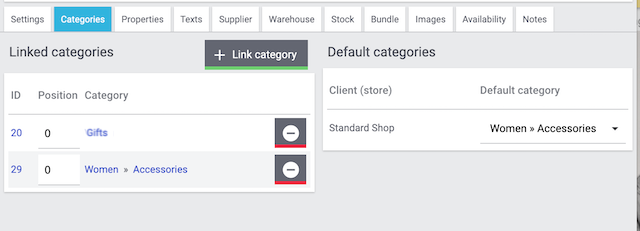
When you export data using a marketplace format the standard category as well as all other categories linked to each item are exported to the marketplace. |
| Field | Explanation |
|---|---|
Category ID |
The ID of the category. |
Category name |
The name of the category. Corresponds to the option in the menu: Items & Stock » Categories » [Open category] » Tab: Settings » Entry field: Name Note: You can re-use category names as long as they are used in different categories or on different levels. Within one category, however, the names may only be used once per level. SEO tip: Enter different meta titles and meta descriptions for categories of the same name. |
Category description |
The text and HTML formatting saved in the tab Description 1. Corresponds to the option in the menu: Item » Category » [Open category] » Tab: Description 1 |
URL name |
The category’s URL name. Corresponds to the option in the menu: Items & Stock » Categories » [Open category] » Tab: Settings » Entry field: URL name |
Meta title |
The category’s meta title. The meta title is displayed in the tab title of the browser and in search engine results. Corresponds to the option in the menu: Items & Stock » Categories » [Open category] » Tab: Settings » Entry field: Meta title |
Meta description |
The category’s meta description. The meta description is analysed by search engines. As such, it is especially important for the homepage. The meta description should contain the most important content in one sentence. Corresponds to the option in the menu: Items & Stock » Categories » [Open category] » Tab: Settings » Entry field: Meta description |
Meta keywords |
The category’s keywords. Corresponds to the option in the menu: Items & Stock » Categories » [Open category] » Tab: Settings » Entry field: Meta keywords |
1.11. Image
You can use the data source All available images to export all images that are saved to a variation in the menu Item » Items » [Open variation] » Tab: Images to the marketplace.
1.12. ASIN
The "Amazon Standard Identification Number" is a 10-digit, alphanumeric product identification that is provided by Amazon. The ASIN and ISBN are identical for books. The ASIN can be found on Amazon’s product page.
| Field | Explanation |
|---|---|
All |
Corresponds to the option in the menu: Item » Items » [Open variation] » Tab: Sales channels » Section: ASIN/ePID/MOIN » Type: ASIN » Country: All » Column: Value |
Amazon Germany |
The ASIN value for Amazon Germany. Corresponds to the option in the menu: Item » Items » [Open variation] » Tab: Sales channels » Section: ASIN/ePID/MOIN » Type: ASIN » Country: Germany » Column: Value |
Amazon Espania |
The ASIN value for Amazon Espania. Corresponds to the option in the menu: Item » Items » [Open variation] » Tab: Sales channels » Section: ASIN/ePID/MOIN » Type: ASIN » Country: Spain » Column: Value |
Amazon France |
The ASIN value for Amazon France. Corresponds to the option in the menu: Item » Items » [Open variation] » Tab: Sales channels » Section: ASIN/ePID/MOIN » Type: ASIN » Country: France » Column: Value |
Amazon United Kingdom |
The ASIN value for Amazon United Kingdom. Corresponds to the option in the menu: Item » Items » [Open variation] » Tab: Sales channels » Section: ASIN/ePID/MOIN » Type: ASIN » Country: United Kingdom » Column: Value |
Amazon Italy |
The ASIN value for Amazon Italy. Corresponds to the option in the menu: Item » Items » [Open variation] » Tab: Sales channels » Section: ASIN/ePID/MOIN » Type: ASIN » Country: Italy » Column: Value |
Amazon United States |
The ASIN value for Amazon United States. Corresponds to the option in the menu: Item » Items » [Open variation] » Tab: Sales channels » Section: ASIN/ePID/MOIN » Type: ASIN » Country: USA » Column: Value |
1.13. MOIN
The "My OTTO Identification Number" is an alphanumeric product identification that is provided by OTTO Market. Since August 11th, 2021, every product on OTTO Market must have a MOIN.
Note: The MOIN is assigned by OTTO Market. You do not create it yourself. If you sell a product on OTTO Market and it’s also available through other sellers, then all of the offers will have the same MOIN.
| Field | Explanation |
|---|---|
MOIN |
The value of the MOIN. Corresponds to the option in the menu: Item » Items » [Open variation] » Element: ASIN/ePID/MOIN » Type: MOIN » Column: Value |
2. FAQ
-
Click file_download Asynchronous download in the toolbar.
→ The export is started and carried out in the background. You can continue using your system while you wait for the process to finish. -
Once the export file is ready (which usually takes between 30 and 60 minutes), a message will appear in the notification centre (notifications_none).
-
In the notification, click on Download in order to download the export file.
If you use “Item” as a marketplace format (e.g. to transmit your product data to a sales platform), then you can export information about the default category and other linked categories.
If you export a file in CSV or TXT format, then you might only see the word "Array" instead of the actual export values. This happens e.g. when exporting multiple images or when exporting multi-selection properties. This is a known issue and it will be fixed in the future.
Possible workaround 1: You can download a JSON or XML file instead. With these file types, you can see the actual export values.
-
Click on Settings.
-
Scroll down to the section Format settings.
-
Select JSON or XML from the drop-down list Format.
-
Save () the settings and download the file (file_download).
-
Caution: If you want to revise the file and import it again, then keep in mind that the import tool only accepts the file types CSV and TXT.
-
Possible workaround 2: Export the data with the tools FormatDesigner and Elastic Export instead.