OTTO Austria Group
The OTTO Austria Group with its online shops ottoversand.at and universal.at is part of Hamburg’s OTTO Group and one of Austria’s leading e-commerce providers, which is known for its wide range of products, offering fashion, household goods, electronics and much more. Moreover, the OTTO Austria Group also offers the possibility to sell items on different sales channels.
1. Becoming a seller at the OTTO Austria Group
First, reach out to a contact person at the OTTO Austria Group by filling in the contact form. Afterwards, you will receive your access credentials which are required for the setup in PlentyONE.
|
Available sales channels
Your products and offers are directly created and updated at OTTO Austria Group. Afterwards, your products will be available on the respective sales channels that you have agreed on with OTTO Austria Group and can be ordered by your customers. The following sales channels are available: ackermann.ch, baur.de, jelmoli-shop.ch, universal.at and ottoversand.at. |
2. Frequency of data exchange
After you have set up OTTO Austria Group in PlentyONE, data is exchanged with the market in the intervals described in Table 1.
| Data | Interval |
|---|---|
Item export |
once a day |
full offer export (creating and updating offers) |
once a day |
Stock synchronisation |
every 15 minutes |
Price synchronisation |
once a day |
Order import |
every 15 minutes |
Import of cancellations |
every 15 minutes |
3. Setting up the data exchange
In order for the interface to successfully carry out the item export, the offer export, the stock and price synchronisation, the order import and the import of cancellations, certain settings are mandatory. Pay attention to the following list.
| Settings section | Settings |
|---|---|
Item export (incl. prices) |
|
Basic settings for the sales channel |
|
Catalogue settings |
|
Listing settings |
|
Variation settings |
|
Offer export (incl. stock) |
|
Basic settings for the sales channel |
|
Catalogue settings |
|
Listing settings |
|
Variation settings |
|
4. Workflow of an OTTO Austria Group order
-
Your items are listed on the respective OTTO Austria Group sales channel.
-
Customers place an order. At the time the order is placed, the OTTO Austria Group purchases the product from the seller at the set purchase price (except for orders within Switzerland).
-
Customers make their payments to OTTO Austria Group.
Note: The OTTO Austria Group is automatically shown as the invoice recipient in every order (except for orders within Switzerland). -
The order is imported into PlentyONE in status 1 = Incomplete data. At this point, only the stock is reserved, which means that the order cannot yet be processed.
-
Once a day, the status of the orders is changed from status 1 to status 3 (ready for shipping; waiting for payment). The order can now be executed.
-
As long as an order cannot be processed, customers at OTTO Austria Group can still cancel it.
Notes on the invoice:
-
The OTTO Austria Group operates in a classic commission business in connection with a drop shipping business. Therefore, your items are offered in the name and for the account of the respective sales channels. OTTO Austria Group GmbH acts as the central unit for handling all channels (except for activities within Switzerland).
Notes on creating delivery notes:
-
You must create a separate delivery note for each OTTO Austria Group sales channel on which you sell your items. Follow the OTTO Austria Group template and use the DocumentBuilder to create your delivery notes. Make sure to use the template for the respective OTTO Austria Group sales channel.
5. Setting up OTTO Austria Group in PlentyONE
First, add OTTO Austria Group as a sales channel and carry out the basic settings to set up the sales channel in PlentyONE. To do so, proceed as described below.
5.1. The Channel Control Centre
In the Channel Control Centre you can find an overview of the sales channels set up in your system.
Table 3 explains the different tiles visible in the Sales channels » Channel Control Centre menu.
| Component | Explanation | ||||||
|---|---|---|---|---|---|---|---|
Name |
The name of the sales channel. |
||||||
more_vert More |
Click here to display more actions for a sales channel.
|
5.2. Adding the sales channel OTTO Austria Group
Add OTTO Austria Group as a sales channel in the Channel Control Centre.
Adding a sales channel:
-
Open the Sales channels » Channel Control Centre menu.
-
Click Add sales channel (add).
→ The menu Add sales channel opens. -
Click Continue in the tile of OTTO Austria Group.
-
Enter a name for the sales channel.
-
If asked to, select the Client (Shop) from the drop-down list.
-
Click add Add OTTO Austria Group.
→ The sales channel for OTTO Austria Group is added.
5.3. Carrying out the channel settings for OTTO Austria Group
Next, carry out the channel settings for OTTO Austria Group.
Carrying out the channel settings for OTTO Austria Group:
-
Open the Sales channels » Channel Control Centre menu.
-
Click on the tile for OTTO Austria Group.
→ The tab Channel settings opens. -
Carry out the settings. Pay attention to the explanations given in Table 4.
Note: You can only configure the settings in the General, Orders and Data exchange sections once you have correctly entered the client API key correctly and saved the settings. -
Save () the settings.
| Setting | Explanation |
|---|---|
FTP credentials |
|
FTP user name |
Enter the FTP user name you received from OTTO Austria Group. |
FTP password |
Enter the FTP password you received from OTTO Austria Group. |
API credentials |
|
API user name |
Enter the API user name you received from OTTO Austria Group. |
API password |
Enter the API password you received from OTTO Austria Group. |
General |
|
Seller ID |
Enter the seller ID that you received from OTTO Austria Group. |
Sales Channels |
Select the sales channels on which you want to offer your products from the drop-down list. |
Crons |
|
Cron for order import |
Activate the toggle button (toggle_on) in order to activate the cron for the order import. |
Cron for item export |
Activate the toggle button (toggle_on) in order to activate the cron for the item export. |
Cron for offer updates |
Activate the toggle button (toggle_on) in order to activate the cron for the offer updates. |
Map shipping service providers |
|
Add mapping |
Click Add mapping (add) to create mappings for shipping profiles. |
5.4. Modifying the general settings
In the menu General settings you may adjust how the sales channel appears and behaves in your system. The functions in this menu are explained in detail in this chapter.
5.4.1. Renaming the sales channel
You can rename the sales channel at any time via the general settings. To do so, proceed as follows.
Renaming a sales channel:
-
Go to Sales channels » Channel Control Centre.
-
Open the sales channel for OTTO Austria Group.
→ The General settings menu opens. -
Enter a new Channel name.
-
Click Save (save).
→ The new channel name is saved.
5.4.2. (De)activating the data exchange
You can completely activate or deactivate the data exchange of a sales channel with its respective marketplace via a single toggle in the general settings. To do so, proceed as follows.
(De)activating the data exchange:
-
Go to Sales channels » Channel Control Centre.
-
Open the sales channel for OTTO Austria Group.
-
Switch to the menu settings General settings.
-
Activate the Data exchange active toggle to activate the data exchange between your PlentyONE system and the marketplace.
OR: Deactivate the Data exchange active toggle to deactivate the data exchange between your PlentyONE system and the marketplace. -
Click Save (save) to save your settings.
6. Activating the order referrer
Go to Setup » Orders » Order referrer to activate the order referrer. This ensures that orders are assigned to the correct sales channel.
An order referrer tags an order with the sales channel on which the order was generated. Sales channels can be e.g. your online shop or markets on which you sell your items. Each sales channel has an individual order referrer. Some order referrers are available by default in your PlentyONE system. Further order referrers are added e.g. if you install a new plugin. For further information about the order referrer, see the page Order referrer of the PlentyONE manual.
Activating the order referrer for OTTO Austria Group:
-
Go to Setup » Orders » Order referrer.
-
Click Search (search).
-
In the list, navigate to the option OTTO Versand AT with the ID 184.01 or Universal AT with the ID 184.02 or Baur DE with the ID 184.05.
Note: If you want to sell your items on all sales channels, activate all three order referrers: OTTO Versand AT, Universal AT and Baur DE. -
On the right of the referrer’s line, click Edit (edit).
→ The window Edit referrer opens. -
Activate the option Visible in selection (toggle_on).
-
Click SAVE (save).
→ The referrer is active.
7. Exporting product data
Product data is exported to OTTO Austria Group using catalogues. Catalogues are usually managed via the Data » Catalogues menu. However, you can create catalogues for OTTO Austria Group via the Channel Control Centre as well.
Catalogues are used to export data from your PlentyONE system. There are two different catalogue formats:
-
Marketplace formats are used to export item data to markets.
-
Standard formats are used to export data from your PlentyONE system into a file.
Catalogues with marketplace formats allow you to tailor your item information exactly to the needs of the market. Because here, you assign a suitable PlentyONE data field to each of the data fields of the market. When your variation data is exported to the market, the market’s data fields are then filled with the correct PlentyONE data.
-
Is this your first time working with catalogues? Then read up on the basic concept of catalogues first.
Additionally, to simplify the creation of new catalogues, you can manage them via Channel maps. With Channel maps, you can create cross-category mappings for a sales channel and apply them to catalogues afterwards. All linked catalogues automatically inherit the mapping from the Channel map. This will save you a lot of time as you don’t need to carry out the mappings for each catalogue.
You can find more information on Channel maps in the Channel maps section.
7.1. Creating a channel map for product data exports
To export your items to OTTO Austria Group, create a channel map in the Channel Control Centre. Then link product catalogues to the channel map and map the OTTO Austria Group data fields to item data saved in PlentyONE in the channel map.
Once you have activated the data exchange, product catalogue, listings and variations, your product data is automatically exported to OTTO Austria Group once a day.
First, create a channel map for mapping your product data. To do so, proceed as follows:
Creating a product channel map:
-
Open the menu Sales channels » Channel Control Centre » [Name of your sales channel] » Mapping » Product mapping.
-
Click on Create Channel map (add).
-
Enter a name for the channel map.
-
In the drop-down list Marketplace, select the option OTTO Austria.
-
In the drop-down list Catalogue type, select the option Product.
-
In the drop-down list Categories, select the product categories you want to sell on .
-
Click on CREATE CHANNEL MAP.
→ The channel map is created.
Once you have created a channel map for OTTO Austria Group you can proceed to create catalogues for the different product types you want to sell on OTTO Austria Group and link them to the channel map. To do so, proceed as follows:
Linking a product catalogue to the channel map:
-
Go to Sales channels » Channel Control Centre » [Name of your sales channel] » Mapping » Product mapping.
-
In the row of the channel map you want to edit, click on more_vert More and select Connect catalogues.
-
In the drop-down list Select catalogues, click Create catalogue.
-
Enter a name for the catalogue.
-
In the drop-down list Marketplace, select the option OTTO Austria Group Products.
-
In the drop-down list Export type, select the option Listing.
-
In the drop-down list Categories, select the product categories in which you want to sell on .
-
Click CREATE AND CONNECT TO CHANNEL MAP.
→ The catalogue is created and connected to the channel map.
Note: You need to create a separate product catalogue for each OTTO Austria Group product category that you want to sell your items in.
7.1.1. Mapping data fields in the channel map
After you have created a channel map, map the OTTO Austria Group data fields to item data saved in PlentyONE. This chapter describes how you map data fields and what particularities apply for item exports to OTTO Austria Group.
-
The market expects product data that cannot be saved in the PlentyONE item menu? Then create a property for this data. Link this property with your variations. The actual values are saved as property values for this property. Is this your first time working with properties? Then read up on the principles of properties first.
| Availability | Explanation | ||||||
|---|---|---|---|---|---|---|---|
Navigation bar |
You can use the navigation at the left edge of the menu to switch to the catalogue or channel map overviews, or to switch to other channel maps you opened previously. |
||||||
Toolbar |
The toolbar contains useful actions for your channel maps:
|
||||||
Tabs |
While common mappings appear in several catalogues and are carried out for all of them at once, catalogue-specific mappings are only done for one specific catalogue. You can use the two tabs at the top of the detail view to switch between views of the different mapping types. Any changes are applied automatically to all catalogues with the respective mapping types. |
||||||
Sales Channel data fields |
On the left-hand side of the mapping list all data fields available for the sales channel are listed. Mandatory fields are labeled with an asterisk (✱). |
||||||
PlentyONE data fields |
On the right-hand side of the mapping list you can map suitable PlentyONE data fields to the sales channel data fields. |
As soon as you have created a Channel map and the status Ready to use is shown in the overview, you can open the Channel map for further editing. A Channel map identifies all common fields, which are all fields that exist in at least two of the selected categories. The mapping of these fields only needs to be done once and automatically applies to all categories.
In order to carry out data field mappings, proceed as follows.
Mapping data fields in a Channel map:
-
Go to Sales channels » Channel Control Centre.
-
Click on the tile of your sales channel.
-
Navigate to Mapping » Product mapping.
→ The catalogue overview opens. -
In the side navigation on the left, click Channel maps.
→ The Channel maps overview for that sales channel opens. -
Click on the Channel map that you want to edit.
→ The detail view of the Channel map opens. -
Next to a data field, click Add data source +.
-
Select the desired data field from the available categories on the left.
Or: Select an Own value (edit) and enter the respective value. -
At the bottom left, click CONFIRM to apply the mappings.
-
At the top, click Save (save).
→ The changes are saved and all connected catalogues with this mapping are adjusted accordingly.
Note: A blue dot in the side navigation on the left indicates unsaved changes.
|
Mapping key as distinctive feature
Via the so-called mapping keys that are available in the tooltip next to the data field names in the mapping, it is possible to differentiate between data fields with the same name. Thus, the individual mapping key shows to which catalogue the data field belongs so the respective mapping can be carried out. |
|
Changes in mapping affect all connected catalogues
If you change mappings in a Channel map, all connected catalogues with this mapping are updated accordingly. |
|
Removing inherited mapping from a catalogue
If a catalogue is connected to a channel map and there are common fields in the mapping, you can still adjust the mapping for this catalogue and remove the mapping from the Channel map for specific data fields. After the changes, the catalogue is still connected to the Channel map. The changes that have been carried out will only apply to the modified catalogue. Remove inherited mapping from catalogue:
|
In a simple 1:1 mapping, you map a PlentyONE data field to the marketplace data field. If no suitable setting exists in PlentyONE, you can map a property instead.
As such, simple 1:1 mappings allow you to:
-
I want to fill this marketplace data field with the data from this PlentyONE setting.
-
If the data field is empty for a variation, no value is exported for this variation.
Creating a simple 1:1 mapping:
-
Next to the marketplace data field, click on + Add data field.
→ To the left, the list of available PlentyONE data fields are shown in groups. -
Click on the group you need.
→ The PlentyONE data fields of the group are shown. -
Click on the plus to the right of the PlentyONE data field you want to select.
→ The PlentyONE data field is added to the right. -
Click on Confirm.
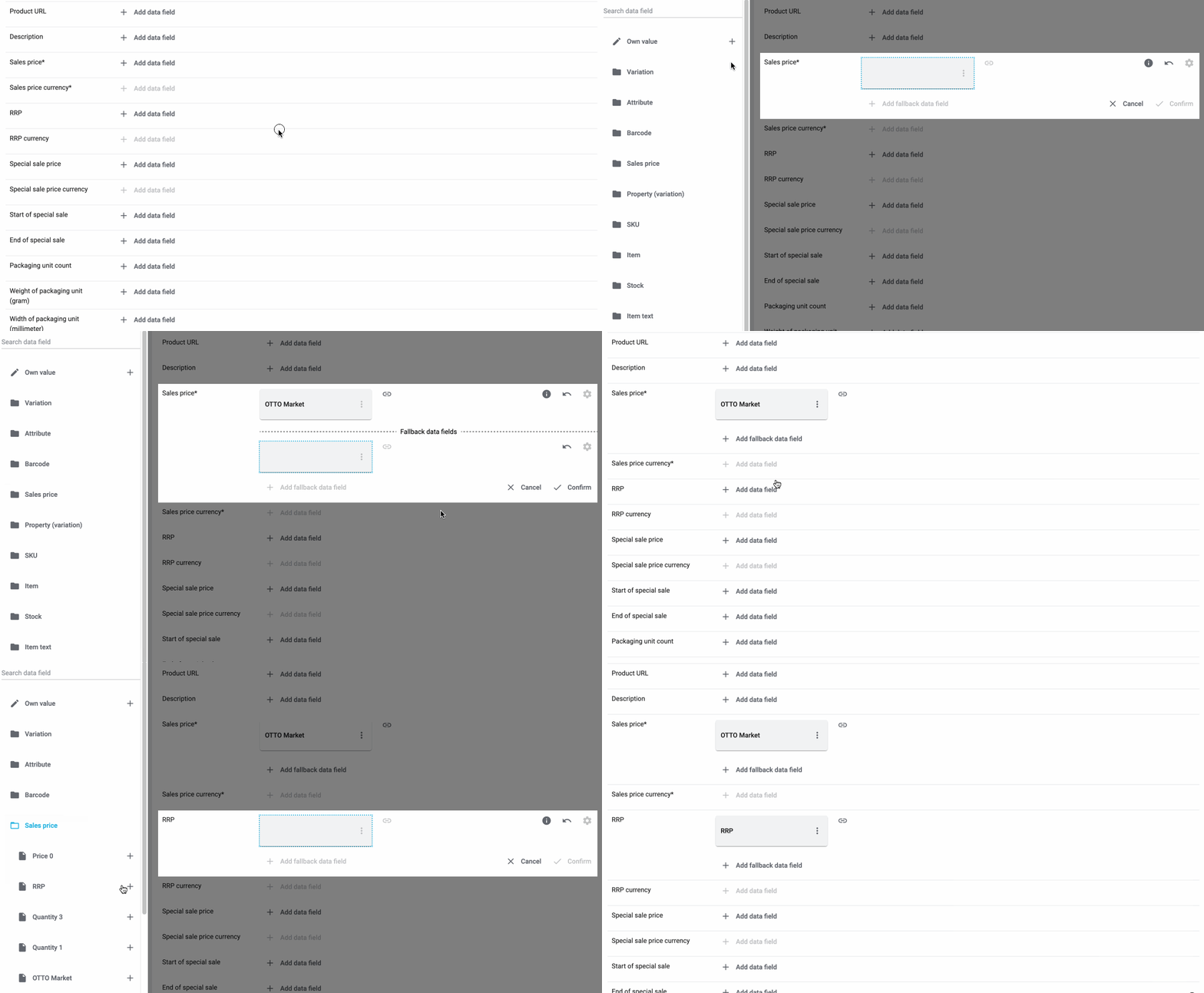
Example: Sales price and RRP for Otto Market
This gif shows you how to map the marketplace data fields Sales price and RRP for Otto Market to PlentyONE data fields:
Reminder: In a simple 1:1 mapping, you map a PlentyONE data field to the marketplace data field. However, what can you do if PlentyONE does not offer a suitable data field? Then it’s the properties' moment to shine. Properties allow you to save any kind of information in your properties.
-
Is this your first time working with properties? Then read up on the principles of properties first.
Creating a property:
-
Create a property with the necessary values.
Tip: Find out how to do that here.
Creating a simple 1:1 mapping with properties:
-
Next to the marketplace data field, click on + Add data field.
→ To the left, the list of available PlentyONE data fields are shown in groups. -
Expand the group Property.
→ The property groups are shown. -
Expand the group you need.
-
Click on the Plus sign on the right of the property you want.
-
From the drop-down list Language, select the language in which you send the data to the market.
-
Click on Confirm.
→ The property is mapped to the marketplace data field.
Like with the simple 1:1 mappings, you map a PlentyONE setting or property to a marketplace data field. Complex mappings are necessary whenever a marketplace data field has more than one possible value. Instead of mapping data fields, for complex mappings you map individual values of these data fields. For example, you cannot simply map the PlentyONE data field Shipping profile to the marketplace data field Shipping method. Why? The market cannot know which of your shipping profiles in PlentyONE corresponds to which of their shipping methods.
| Do not enter own values for complex mappings. All values that you enter must be saved for the variations, either in a setting or as a property value. This also applies if the value Comparative value is shown. You still need to enter exactly the value of the setting or property that you mapped. |
In complex mappings, the value of the market is always exported. Only when you map an own value, the own value that you enter is exported.
You can recognise complex mappings from the field that is shown below the name of the marketplace data field. Click on the field to show the values available for the marketplace data field.

Examples for complex 1:1 mappings are:
-
Categories
-
Brands
-
Shipping setting
Important: For complex mappings, do not map own values or properties of the type None.
Creating a complex 1:1:n mapping:
-
Click on the field for the marketplace data field.
→ A list of the available values is shown. -
Select the value that you want to map a PlentyONE data field to.
→ The value is mapped. -
Next to the marketplace data field, click on + Add data field.
→ To the left, the available PlentyONE data fields are listed in groups. -
Click on a group.
→ The PlentyONE data fields of the group are shown. -
Click on the PlentyONE data field for which you want to map values.
Important: Do not map own values or properties of the type None. -
Your next steps depend on the PlentyONE data field you selected:
-
Alternative 1: The available values for the PlentyONE data value are shown on the left.
-
Next to the value you want to select, click on the plus.
→ The value is added to the field on the right. -
Click on Confirm.
-
-
Alternative 2: The PlentyONE data field is inserted and the field Comparative value is shown.
-
In the field Comparative value, enter a value that is saved in the setting or the property of the mapped PlentyONE data field.
-
Click on Confirm.
-
-
Alternative 3: The PlentyONE data field is inserted and a drop-down list is shown.
-
Select a value from the drop-down list.
-
Click on Confirm.
→ The value of the marketplace data field is exported, not the value of the PlentyONE data field.
Exception: Only when you map an own value, the own value that you enter is exported.
-
-
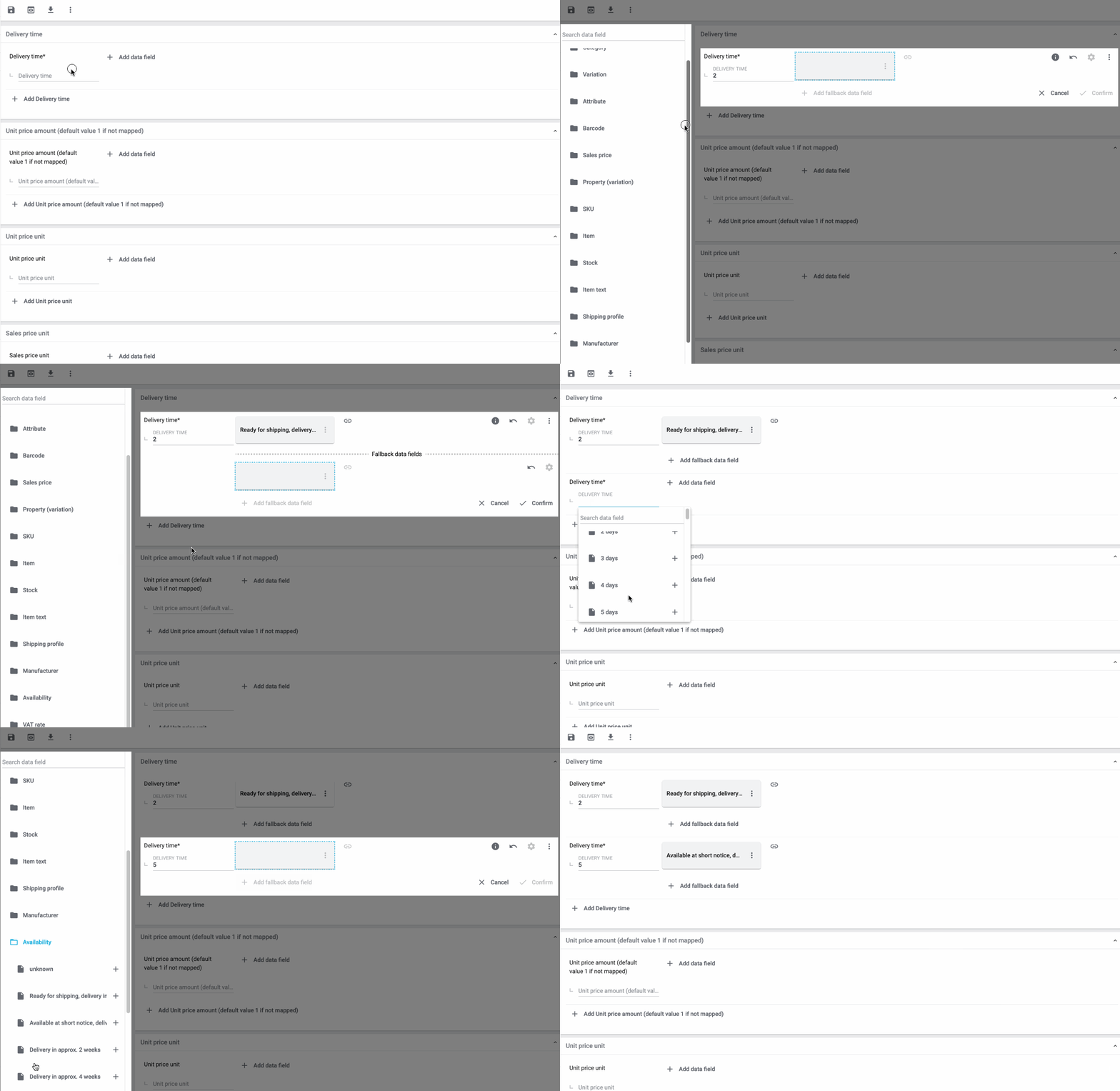
Example: Delivery time in days for Otto Market
This gif shows you how to map suitable PlentyONE values to the values of the marketplace data fields Delivery time in days for Otto Market:
In a 1:1 mapping with one or more fallback data fields, you map a PlentyONE data field to the marketplace data field. In addition, you specify one or more fallback data fields. This ensures that the system keeps looking if the first PlentyONE data field is missing or empty.
So this mapping specifies:
-
I want to fill the marketplace data field with the data from the selected PlentyONE setting.
-
If that data field is missing or empty for a variation, the first fallback data field is checked. The value of that fallback data field is exported instead.
-
If the first fallback data field is also missing or empty for the variation, the second fallback data field is checked. If a value is found, the value of the second fallback data field is exported for the variation etc.
Two separate fallback conditions are available:
Null (default) |
The fallback data field is used if the data field above is mapped in the catalogue but not linked to the variation. The condition "Null" is useful when you want to map fallback data fields for the following types of PlentyONE data fields:
Important: When you add a fallback data field, the fallback condition "null" is selected automatically. To apply the fallback condition "leer", you need to change the default setting. |
Empty |
The fallback data field is used if the data field above is mapped in the catalogue and linked to the variation, but is empty. The condition "Empty" is useful when you want to map fallback data fields for the following type of PlentyONE data fields:
Important: When you add a fallback data field, the fallback condition "null" is selected automatically. To apply the fallback condition "leer", you need to change the default setting. |
Note: Even if you assign one or more fallback data fields, the value of only one of those fields is exported. For each variation, the mapped PlentyONE data fields are checked in the order in which you mapped them. This means that if the first data field does not provide a value for a variation, the first fallback data field is exported etc.
Creating a 1:1 mapping with fallback data fields:
-
Next to the marketplace data field, click on + Add data field.
→ To the left, the list of available PlentyONE data fields are shown in groups. -
Click on the group you need.
→ The PlentyONE data fields of the group are shown. -
Click on the plus to the right of the PlentyONE data field you want to select.
→ The PlentyONE data field is added to the right. -
In the list of PlentyONE data fields, click on the plus icon next to the PlentyONE data field that you want to map.
→ The fallback data field is added with the fallback condition "null". -
Alternative 1: To add the fallback data field with the fallback condition "null":
-
Click on Confirm.
→ The fallback data field is exported if the data field above is not linked to the variation.
-
-
Alternative 2: To add the fallback data field with the fallback condition "empty":
-
To the left of the fallback data field, click on the cog ().
→ The window Data column settings is shown. -
For the setting Fallback condition, select the option Empty.
-
Click on Save.
→ The fallback data field is added with the fallback condition "empty". -
Click on Confirm.
→ The fallback data field is exported if the data field above is empty for the variation.
-
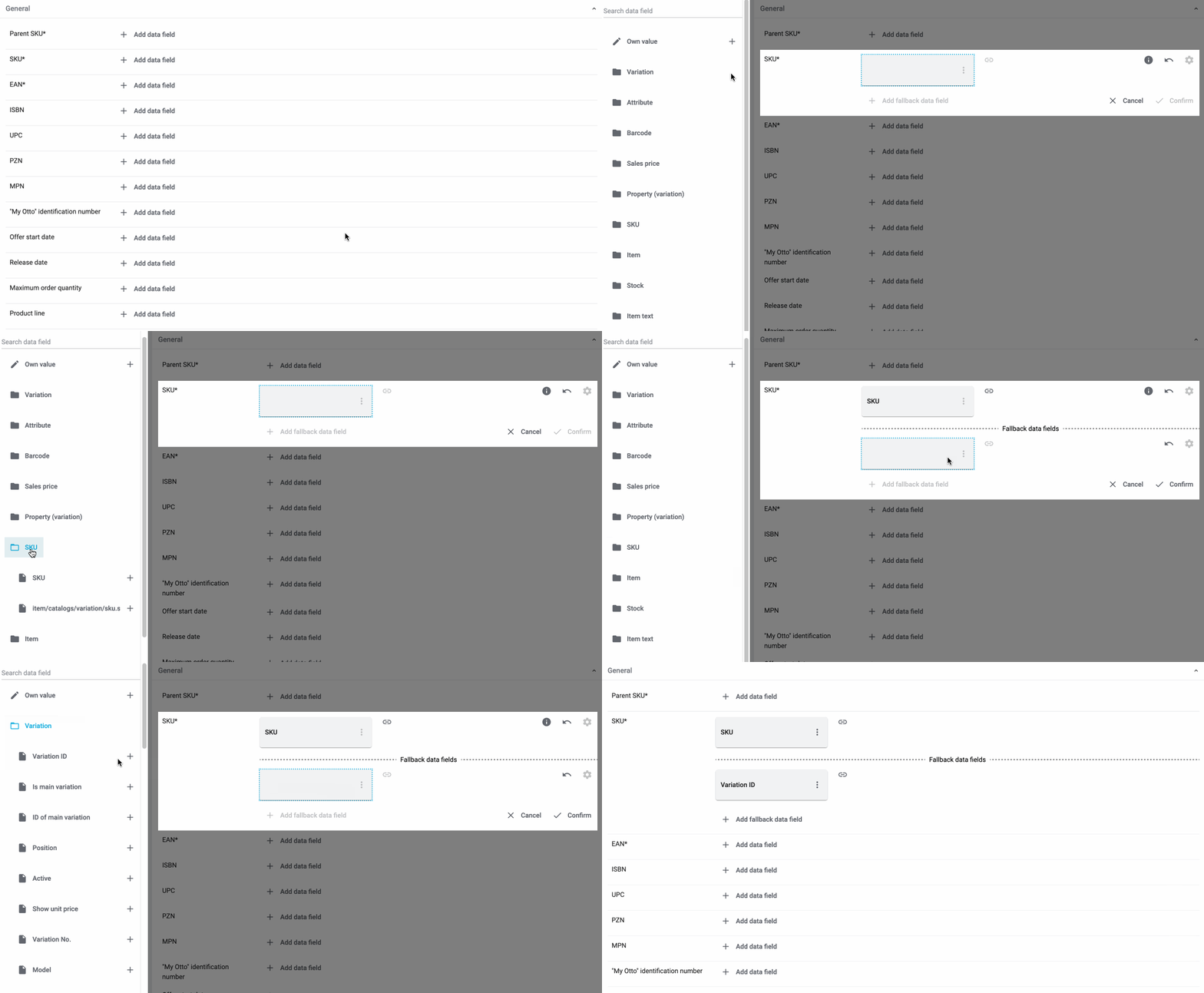
Example: Fallback data field for SKU for Otto Market
This GIF shows you the mapping for the OTTO Market marketplace data field SKU. The PlentyONE data field SKU is mapped to this marketplace data field. The PlentyONE data field Variation ID is mapped as the fallback data field. The fallback condition "null" is applied automatically.
Result: The fallback data field Variation ID is exported if the data field SKU is not linked to the variation.
In a 1:n mapping, you map several PlentyONE data fields to the marketplace data field. You can link these data fields with a separator.
So this mapping specifies:
-
I want to combine these PlentyONE data fields during export so that the marketplace data field is filled with the data of these two or more PlentyONE settings.
Creating a 1:n mapping:
-
Next to the marketplace data field, click on + Add data field.
→ To the left, the list of available PlentyONE data fields are shown in groups. -
Click on the group you need.
→ The PlentyONE data fields of the group are shown. -
Click on the plus to the right of the PlentyONE data field you want to select.
→ The PlentyONE data field is added to the right. -
Click on Confirm.
-
To the right of the mapped PlentyONE data field, click on Add data field ().
→ To the left, the list of available PlentyONE data fields again are shown in groups. -
Map one or several additional PlentyONE data fields to the marketplace data field as described above.
-
Click on Confirm.
-
To the very right of the row, click on Settings ().
-
Select a separator from the drop-down list Separator or add a custom separator.
-
Click on Save.
-
Save () the catalogue.
→ The mappings are saved.
→ During the export, the content of the PlentyONE data fields is combined and exported as one field.
You are sure that you want to export the same value for all variations of a catalogue for a marketplace data field? Then specify an own value. This own value is then exported for all variations.
So this mapping specifies:
-
For this marketplace data field, I want to export the value that I entered in the field Own value for all variations of this catalogue. The value you enter is always exported. The value overwrites the market value also in complex mappings where usually the value of the market is exported. As such, make sure you enter an own value that the market accepts for this marketplace data field.
Creating an own value mapping:
-
Next to the marketplace data field, click on + Add data field.
→ To the left, the list of available PlentyONE data fields are shown in groups. -
Click on the plus next to Own value at the top of the list.
→ The field for the own value is added to the view. -
Enter a value into the input field.
→ This value is exported for all variations.
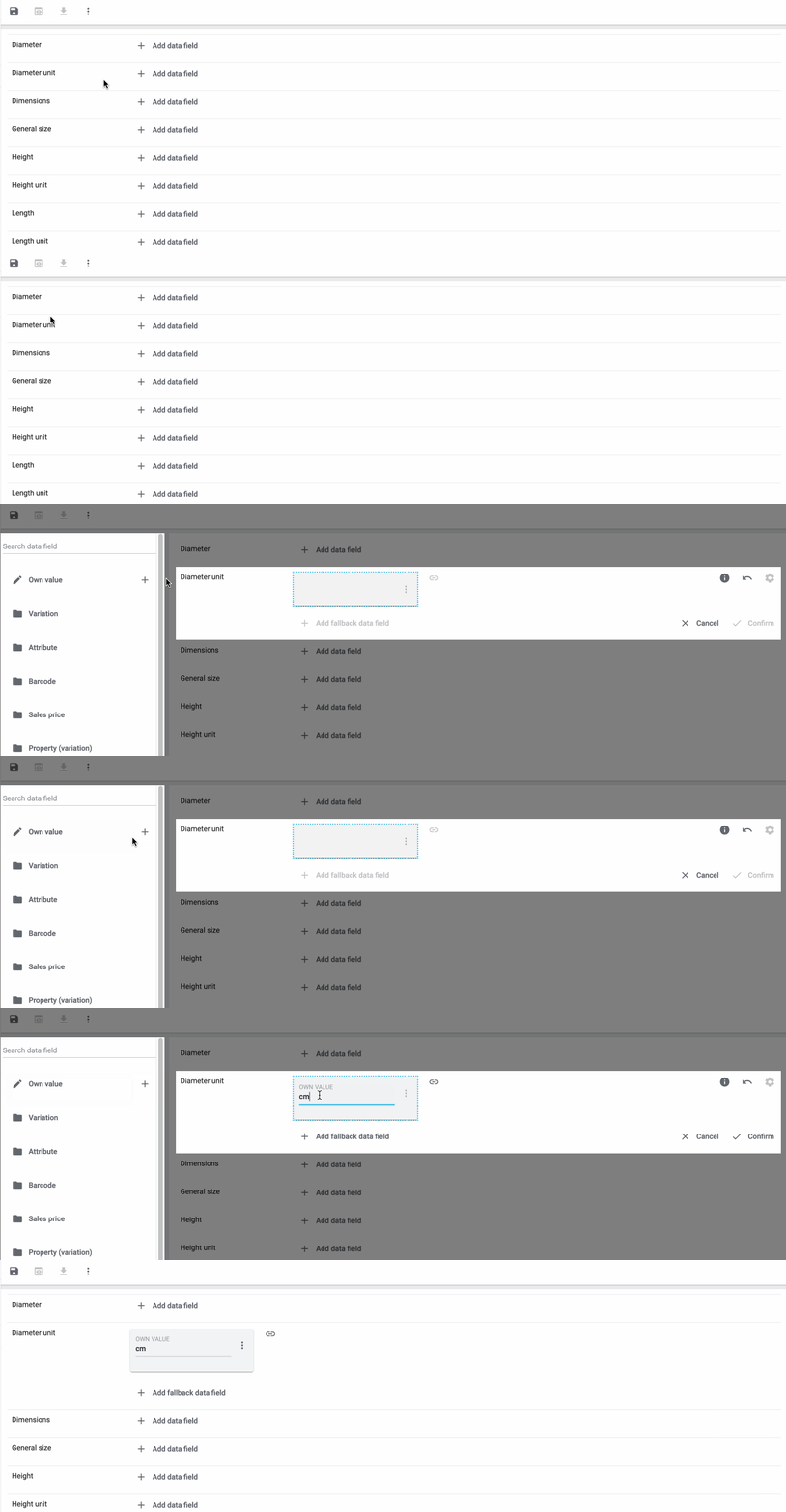
Example: Diameter information
You want to export diameter information for some of your variations. The diameter is saved in centimetres for all your variations. Instead of creating a property for the unit and linking this property to the variations, you can enter the own value cm.
This is an example of how you can map an own value for the diameter unit:
Mathematical calculations allow you to change numerical values automatically during the export.
-
This function only works for data fields that contain numerical values.
-
This functionality is new and not available for all catalogue formats.
So this mapping specifies:
-
I want the numerical value of a PlentyONE data field to be recalculated during the export. Basic arithmetic operations are available for the formulas.
Recalculating numerical values:
-
Next to the marketplace data field, click on + Add data field.
→ To the left, the list of available PlentyONE data fields are shown in groups. -
At the very top of the list, click on the plus icon next to Formula (calculate).
→ The data field Formula is added to the field on the right. -
Click into the data field.
→ The window Modify value is shown. -
Enter a numerical value or select a PlentyONE data field at the bottom right of the window to add it to the calculation (add).
Tip: Use the search function. This helps you to find data fields quickly. -
Optional: If the symbol more_vert is shown in the data field, select the correct assignment for the data field.
Tip: A number tells you how many assignments are necessary for the data field.-
Click on the icon more_vert.
-
In the window shown, select the assignments from the drop-down list.
-
Save the settings.
-
-
Enter numbers and mathematical operators with the on-screen calculator or the keyboard.
-
Save the settings.
→ The entered formula is displayed in the overview.
→ The calculation will be carried out in the next export.
7.1.2. Recommendations for data field mappings
To help you with mapping your data fields for the catalogue, we have created a list of recommended data field mappings. Note that these mappings are recommendations only. Depending on how you manage your item data, other mappings may be more appropriate than the recommendation given here.
-
Need more information about the PlentyONE data fields? All data fields are described on the manual page for the export type Listing.
| Sales channel field | Mandatory? | Recommended PlentyONE mapping |
|---|---|---|
Name |
yes |
or
or
or
|
Article ID |
yes |
The variation ID is mapped automatically. |
Product ID |
yes |
The Item ID is mapped automatically. |
Description |
yes |
|
GTIN |
yes |
GTIN Barcode
|
Commission Rate |
yes |
The commission rate agreed with OTTO Austria Group.
|
Category ID |
yes |
The Category ID is mapped automatically. |
Availability |
yes |
The value from the Referrer » Referrer ID field is mapped automatically. |
OAG Purchase Price |
yes |
The purchase price that paid for the product.
Note: The sales price is calculated automatically based on the mapped OAG Purchase Price, the Commission Rate, and the *Tax (VAT rate). |
Pieces |
yes |
Number of packing units
|
Width |
yes |
Width of the product
|
Height |
yes |
Height of the product
|
Length |
yes |
Length of the product
|
Weight |
yes |
Weight of the product
|
Intrastat (CN code) |
yes |
This is an 8-digit code for identifying and categorizing stock that is traded between the EU member states.
|
Origin country |
yes |
The origin country of the product
|
Bullet Point 1 |
yes |
Select the property for bullet point 1.
|
Bullet Point 2 |
yes |
Select the property for bullet point 2.
|
Bullet Point 3 |
yes |
Select the property for bullet point 3.
|
Brand |
yes |
This data field contains a complex mapping. Click in the Export as field and select the brand from the drop-down list. In the field next to it, specify the condition under which the defined value should be exported. |
Media (images): |
no |
Recommendation: Add at least one picture of the front and back view.
|
Farbe |
yes |
Colour of the product. Property » no group (automatically generated) » Color |
Materialzusammensetzung 1 |
yes |
This data field contains a complex mapping. Click in the Export as field and select the material from the drop-down list. In the field next to it, specify the condition under which the defined value should be exported. Also enter the percentage for the selected material using an Own value. |
Geschlecht |
yes |
This data field contains a complex mapping. Click in the Export as field and select the gender from the drop-down list. In the field next to it, specify the condition under which the defined value should be exported. |
Zielgruppe |
yes |
This data field contains a complex mapping. Click in the Export as field and select the target group from the drop-down list. In the field next to it, specify the condition under which the defined value should be exported. |
Produkttyp |
yes |
This data field contains a complex mapping. Click in the Export as field and select the product type from the drop-down list. In the field next to it, specify the condition under which the defined value should be exported. |
Marktkennzeichen |
yes |
This data field contains a complex mapping. Click in the Export as field and select the market indicator from the drop-down list. In the field next to it, specify the condition under which the defined value should be exported. |
Größentyp |
yes |
This data field contains a complex mapping. Click in the Export as field and select the size type from the drop-down list. In the field next to it, specify the condition under which the defined value should be exported. |
Größe |
yes |
This data field contains a complex mapping. Click in the Export as field and select the size from the drop-down list. In the field next to it, specify the condition under which the defined value should be exported. |
EKR_Farbe |
yes |
This data field contains a complex mapping. Click in the Export as field and select the colour from the drop-down list. In the field next to it, specify the condition under which the defined value should be exported. |
Materialkomponente 1 |
yes |
This data field contains a complex mapping. Click in the Export as field and select the value for the material component from the drop-down list. In the field next to it, specify the condition under which the defined value should be exported. |
variationID |
yes |
The variation ID is mapped automatically. |
7.1.3. Particularities for mapping data fields in the product catalogue
Calculation of the sales price
The sales price for the product on OTTO Austria Group is not mapped directly. Instead, it is calculated automatically based on the mapped OAG Purchase Price, the Commission Rate, and the Tax (VAT rate). For this reason, the sales price can only be viewed in the preview of the export results for the product listing.
We recommend the following mapping for the OAG Purchase Price:
-
Variation » Net purchase price
Note: The value for the OAG Purchase Price must always be lower than the Recommended price (MSRP).
You can view the automatically calculated sales price in the preview of the export results for the product listing.
Prerequisites:
-
You have created a product catalogue for OTTO Austria Group.
-
You have mapped all required fields for OTTO Austria Group, including:
-
Data field OAG Purchase Price → Data source Variation » Net purchase price
-
Data field Commission Rate → Data source Own value
Note: Enter the commission rate agreed with OTTO Austria Group.
-
-
You have created a product listing for OTTO Austria Group.
Note: Under Catalogue, select the product catalogue that contains your mappings for OAG Purchase Price and Commission Rate.
Viewing the sales price in the export results preview:
-
In the Product listings menu, click more_vert at the end of the product listing’s row.
→ A drop-down list with further options appears. -
Click preview Preview export results.
→ The preview opens in a separate window. -
Expand the following objects in order:
-
0: Object
-
data: Object
-
price: Object
-
-
Next to sale_price: you will see the automatically calculated sales price.
7.1.4. Providing information on manufacturer and EU-responsible person
The General Product Safety Regulation of the EU (GPSR) requires manufacturers and sellers to ensure the product safety of certain goods and to provide certain information for this purpose. This information includes details about the manufacturer and, in the case of manufacturers without an establishment in the EU, details about the responsible person within the EU. The GPSR regulation ensures that products are safe and comply with consumer protection requirements before being placed on the market.
In the catalogue for OTTO Austria Group, the details on the manufacturer and the EU-responsible person are already mapped in the Attributes section. No further steps are required.
7.1.5. Activating the catalogue export
You have set up OTTO Austria Group in PlentyONE and created a catalogue for exporting your item data? Then activate the catalogues you want to export to OTTO Austria Group in the Data » Catalogues menu and continue with creating product listings.
Once you have activated the product catalogue, the data exchange, the product listing and the variations, the product data will be automatically exported to OTTO Austria Group once a day.
Activating the channel map export to OTTO Austria Group:
-
Open the menu Sales channels » Channel Control Centre » [Your OTTO Austria Group sales channel] » Mapping » Product mapping.
-
Navigate to the row of your OTTO Austria Group channel map and click on the field in the Connected catalogues column.
→ The Connected catalogues overview is displayed for the channel map. -
In the list of connected catalogues, activate all product catalogues you want to export.
-
Click SAVE.
→ The connected catalogues are (de)activated.
→ The item data mapped in the channel map and all connected and activated catalogues is exported to OTTO Austria Group once a day.
Tip: Go to Data & Plugins » Catalogue export status for information about the status of the export.
8. Exporting offer data
Offer data is exported to OTTO Austria Group using catalogues. Catalogues are usually managed via the Data » Catalogues menu. However, you can create catalogues for OTTO Austria Group via the Channel Control Centre as well.
Catalogues are used to export data from your PlentyONE system. There are two different catalogue formats:
-
Marketplace formats are used to export item data to markets.
-
Standard formats are used to export data from your PlentyONE system into a file.
Catalogues with marketplace formats allow you to tailor your item information exactly to the needs of the market. Because here, you assign a suitable PlentyONE data field to each of the data fields of the market. When your variation data is exported to the market, the market’s data fields are then filled with the correct PlentyONE data.
-
Is this your first time working with catalogues? Then read up on the basic concept of catalogues first.
8.1. Creating an offer catalogue
Go to the Channel Control Centre to create offer catalogues for OTTO Austria Group. Afterwards, link the OTTO Austria Group data fields with offer data saved in PlentyONE in the catalogue you created. If you have activated the catalogue, the data exchange, the listing and the variations, the offer data is automatically exported to OTTO Austria Group once a day.
Creating a catalogue:
-
Go to Sales channels » Channel Control Centre.
-
Click on the OTTO Austria Group tile.
-
Go to Mapping » Offer mapping.
-
Click Create catalogue (add).
-
Enter a name for the catalogue.
-
In the drop-down list Marketplace, select the option OTTO Austria Group Offers.
-
In the drop-down list Export type, select the option Listing.
-
In the drop-down list Category, select the option OTTO Austria Group Offers.
-
Save () the settings.
→ The catalogue is created.
→ The catalogue is opened for editing.
Other catalogue settings
Other catalogue settings are optional. Once you carried out the settings described on this page, your catalogue is automatically exported to OTTO Austria Group. That means you can ignore the catalogue settings for Format settings, Export settings and Download settings.
The Format settings, Export settings, and Download settings allow you to create a file with the variation data contained in the catalogue. However, this file does not contain information about whether the data export to OTTO Austria Group was successful.
|
Do not change the format in the catalogue’s Format settings. To ensure that the export to the sales channel works, all required settings are already configured when you create a catalogue. If you change the settings, errors might occur during the export. |
8.1.1. Mapping data fields in the offer catalogue
After you have created an offer catalogue, map the channel’s data fields to item data saved in PlentyONE. This chapter describes how you map data fields and what particularities apply for item exports to OTTO Austria Group.
-
The market expects product data that cannot be saved in the PlentyONE item menu? Then create a property for this data. Link this property with your variations. The actual values are saved as property values for this property. Is this your first time working with properties? Then read up on the principles of properties first.
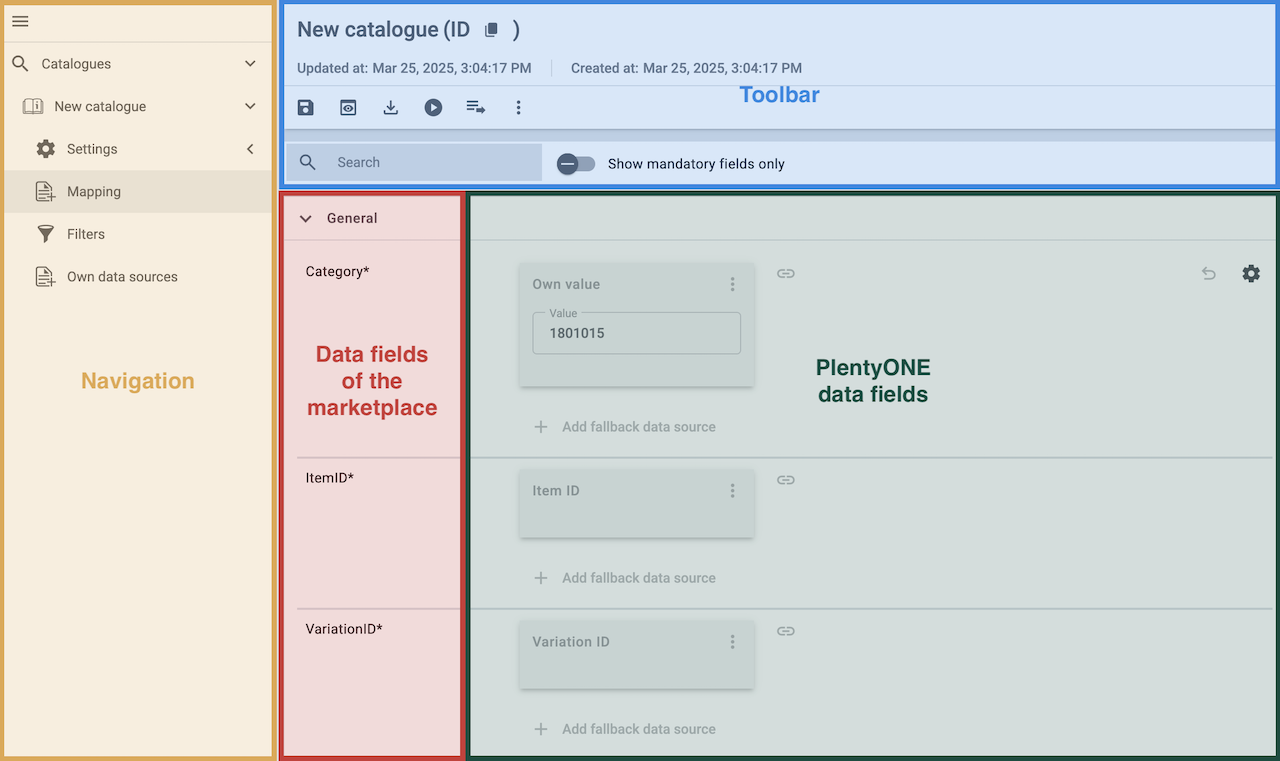
| Availability | Explanation |
|---|---|
Navigation |
When you open a catalogue, the view Mapping is shown. On the very left is the navigation.
|
Toolbar |
The toolbar provides actions for the catalogue. For example, save your mappings, restore an older version of the catalogue or hide or show optional marketplace data fields. |
Marketplace data field |
To the right of the navigation, all data fields available for the market are listed. Mandatory fields are marked with an asterisk (✱). |
PlentyONE data fields |
On the right side of the catalogue, you map the marketplace data fields to appropriate PlentyONE data fields. In the screenshot above, a few of the fields are already mapped. |
Mapping catalogue fields:
-
Go to Sales channels » Channel Control Centre.
-
Click on the tile of your OTTO Austria Group sales channel.
-
Click on the catalogue you want to edit.
→ The Mapping tab opens.
→ In the left-hand column, the market’s data fields are listed.
Tip: Mandatory fields are flagged with an asterisk (*).
→ In the right column, you map the PlentyONE data fields. Any PlentyONE data fields that you already mapped are also shown in this column. -
Map suitable PlentyONE data fields to the market data fields.
For each marketplace data field, you have a number of mapping options. Expand the info boxes below to get more information about each of these mapping options.-
Simple 1:1 mapping
-
Simple 1:1 mapping with properties
-
Complex 1:1 mapping
-
1:1 mapping with fallback data fields
-
1:n mapping
-
Own value mapping
-
Mapping with mathematical calculations
-
-
Save () the catalogue.
→ The mappings are saved.
In a simple 1:1 mapping, you map a PlentyONE data field to the marketplace data field. If no suitable setting exists in PlentyONE, you can map a property instead.
As such, simple 1:1 mappings allow you to:
-
I want to fill this marketplace data field with the data from this PlentyONE setting.
-
If the data field is empty for a variation, no value is exported for this variation.
Creating a simple 1:1 mapping:
-
Next to the marketplace data field, click on + Add data field.
→ To the left, the list of available PlentyONE data fields are shown in groups. -
Click on the group you need.
→ The PlentyONE data fields of the group are shown. -
Click on the plus to the right of the PlentyONE data field you want to select.
→ The PlentyONE data field is added to the right. -
Click on Confirm.
Example: Sales price and RRP for Otto Market
This gif shows you how to map the marketplace data fields Sales price and RRP for Otto Market to PlentyONE data fields:
Reminder: In a simple 1:1 mapping, you map a PlentyONE data field to the marketplace data field. However, what can you do if PlentyONE does not offer a suitable data field? Then it’s the properties' moment to shine. Properties allow you to save any kind of information in your properties.
-
Is this your first time working with properties? Then read up on the principles of properties first.
Creating a property:
-
Create a property with the necessary values.
Tip: Find out how to do that here.
Creating a simple 1:1 mapping with properties:
-
Next to the marketplace data field, click on + Add data field.
→ To the left, the list of available PlentyONE data fields are shown in groups. -
Expand the group Property.
→ The property groups are shown. -
Expand the group you need.
-
Click on the Plus sign on the right of the property you want.
-
From the drop-down list Language, select the language in which you send the data to the market.
-
Click on Confirm.
→ The property is mapped to the marketplace data field.
Like with the simple 1:1 mappings, you map a PlentyONE setting or property to a marketplace data field. Complex mappings are necessary whenever a marketplace data field has more than one possible value. Instead of mapping data fields, for complex mappings you map individual values of these data fields. For example, you cannot simply map the PlentyONE data field Shipping profile to the marketplace data field Shipping method. Why? The market cannot know which of your shipping profiles in PlentyONE corresponds to which of their shipping methods.
| Do not enter own values for complex mappings. All values that you enter must be saved for the variations, either in a setting or as a property value. This also applies if the value Comparative value is shown. You still need to enter exactly the value of the setting or property that you mapped. |
In complex mappings, the value of the market is always exported. Only when you map an own value, the own value that you enter is exported.
You can recognise complex mappings from the field that is shown below the name of the marketplace data field. Click on the field to show the values available for the marketplace data field.
Examples for complex 1:1 mappings are:
-
Categories
-
Brands
-
Shipping setting
Important: For complex mappings, do not map own values or properties of the type None.
Creating a complex 1:1:n mapping:
-
Click on the field for the marketplace data field.
→ A list of the available values is shown. -
Select the value that you want to map a PlentyONE data field to.
→ The value is mapped. -
Next to the marketplace data field, click on + Add data field.
→ To the left, the available PlentyONE data fields are listed in groups. -
Click on a group.
→ The PlentyONE data fields of the group are shown. -
Click on the PlentyONE data field for which you want to map values.
Important: Do not map own values or properties of the type None. -
Your next steps depend on the PlentyONE data field you selected:
-
Alternative 1: The available values for the PlentyONE data value are shown on the left.
-
Next to the value you want to select, click on the plus.
→ The value is added to the field on the right. -
Click on Confirm.
-
-
Alternative 2: The PlentyONE data field is inserted and the field Comparative value is shown.
-
In the field Comparative value, enter a value that is saved in the setting or the property of the mapped PlentyONE data field.
-
Click on Confirm.
-
-
Alternative 3: The PlentyONE data field is inserted and a drop-down list is shown.
-
Select a value from the drop-down list.
-
Click on Confirm.
→ The value of the marketplace data field is exported, not the value of the PlentyONE data field.
Exception: Only when you map an own value, the own value that you enter is exported.
-
-
Example: Delivery time in days for Otto Market
This gif shows you how to map suitable PlentyONE values to the values of the marketplace data fields Delivery time in days for Otto Market:
In a 1:1 mapping with one or more fallback data fields, you map a PlentyONE data field to the marketplace data field. In addition, you specify one or more fallback data fields. This ensures that the system keeps looking if the first PlentyONE data field is missing or empty.
So this mapping specifies:
-
I want to fill the marketplace data field with the data from the selected PlentyONE setting.
-
If that data field is missing or empty for a variation, the first fallback data field is checked. The value of that fallback data field is exported instead.
-
If the first fallback data field is also missing or empty for the variation, the second fallback data field is checked. If a value is found, the value of the second fallback data field is exported for the variation etc.
Two separate fallback conditions are available:
Null (default) |
The fallback data field is used if the data field above is mapped in the catalogue but not linked to the variation. The condition "Null" is useful when you want to map fallback data fields for the following types of PlentyONE data fields:
Important: When you add a fallback data field, the fallback condition "null" is selected automatically. To apply the fallback condition "leer", you need to change the default setting. |
Empty |
The fallback data field is used if the data field above is mapped in the catalogue and linked to the variation, but is empty. The condition "Empty" is useful when you want to map fallback data fields for the following type of PlentyONE data fields:
Important: When you add a fallback data field, the fallback condition "null" is selected automatically. To apply the fallback condition "leer", you need to change the default setting. |
Note: Even if you assign one or more fallback data fields, the value of only one of those fields is exported. For each variation, the mapped PlentyONE data fields are checked in the order in which you mapped them. This means that if the first data field does not provide a value for a variation, the first fallback data field is exported etc.
Creating a 1:1 mapping with fallback data fields:
-
Next to the marketplace data field, click on + Add data field.
→ To the left, the list of available PlentyONE data fields are shown in groups. -
Click on the group you need.
→ The PlentyONE data fields of the group are shown. -
Click on the plus to the right of the PlentyONE data field you want to select.
→ The PlentyONE data field is added to the right. -
In the list of PlentyONE data fields, click on the plus icon next to the PlentyONE data field that you want to map.
→ The fallback data field is added with the fallback condition "null". -
Alternative 1: To add the fallback data field with the fallback condition "null":
-
Click on Confirm.
→ The fallback data field is exported if the data field above is not linked to the variation.
-
-
Alternative 2: To add the fallback data field with the fallback condition "empty":
-
To the left of the fallback data field, click on the cog ().
→ The window Data column settings is shown. -
For the setting Fallback condition, select the option Empty.
-
Click on Save.
→ The fallback data field is added with the fallback condition "empty". -
Click on Confirm.
→ The fallback data field is exported if the data field above is empty for the variation.
-
Example: Fallback data field for SKU for Otto Market
This GIF shows you the mapping for the OTTO Market marketplace data field SKU. The PlentyONE data field SKU is mapped to this marketplace data field. The PlentyONE data field Variation ID is mapped as the fallback data field. The fallback condition "null" is applied automatically.
Result: The fallback data field Variation ID is exported if the data field SKU is not linked to the variation.
In a 1:n mapping, you map several PlentyONE data fields to the marketplace data field. You can link these data fields with a separator.
So this mapping specifies:
-
I want to combine these PlentyONE data fields during export so that the marketplace data field is filled with the data of these two or more PlentyONE settings.
Creating a 1:n mapping:
-
Next to the marketplace data field, click on + Add data field.
→ To the left, the list of available PlentyONE data fields are shown in groups. -
Click on the group you need.
→ The PlentyONE data fields of the group are shown. -
Click on the plus to the right of the PlentyONE data field you want to select.
→ The PlentyONE data field is added to the right. -
Click on Confirm.
-
To the right of the mapped PlentyONE data field, click on Add data field ().
→ To the left, the list of available PlentyONE data fields again are shown in groups. -
Map one or several additional PlentyONE data fields to the marketplace data field as described above.
-
Click on Confirm.
-
To the very right of the row, click on Settings ().
-
Select a separator from the drop-down list Separator or add a custom separator.
-
Click on Save.
-
Save () the catalogue.
→ The mappings are saved.
→ During the export, the content of the PlentyONE data fields is combined and exported as one field.
You are sure that you want to export the same value for all variations of a catalogue for a marketplace data field? Then specify an own value. This own value is then exported for all variations.
So this mapping specifies:
-
For this marketplace data field, I want to export the value that I entered in the field Own value for all variations of this catalogue. The value you enter is always exported. The value overwrites the market value also in complex mappings where usually the value of the market is exported. As such, make sure you enter an own value that the market accepts for this marketplace data field.
Creating an own value mapping:
-
Next to the marketplace data field, click on + Add data field.
→ To the left, the list of available PlentyONE data fields are shown in groups. -
Click on the plus next to Own value at the top of the list.
→ The field for the own value is added to the view. -
Enter a value into the input field.
→ This value is exported for all variations.
Example: Diameter information
You want to export diameter information for some of your variations. The diameter is saved in centimetres for all your variations. Instead of creating a property for the unit and linking this property to the variations, you can enter the own value cm.
This is an example of how you can map an own value for the diameter unit:
Mathematical calculations allow you to change numerical values automatically during the export.
-
This function only works for data fields that contain numerical values.
-
This functionality is new and not available for all catalogue formats.
So this mapping specifies:
-
I want the numerical value of a PlentyONE data field to be recalculated during the export. Basic arithmetic operations are available for the formulas.
Recalculating numerical values:
-
Next to the marketplace data field, click on + Add data field.
→ To the left, the list of available PlentyONE data fields are shown in groups. -
At the very top of the list, click on the plus icon next to Formula (calculate).
→ The data field Formula is added to the field on the right. -
Click into the data field.
→ The window Modify value is shown. -
Enter a numerical value or select a PlentyONE data field at the bottom right of the window to add it to the calculation (add).
Tip: Use the search function. This helps you to find data fields quickly. -
Optional: If the symbol more_vert is shown in the data field, select the correct assignment for the data field.
Tip: A number tells you how many assignments are necessary for the data field.-
Click on the icon more_vert.
-
In the window shown, select the assignments from the drop-down list.
-
Save the settings.
-
-
Enter numbers and mathematical operators with the on-screen calculator or the keyboard.
-
Save the settings.
→ The entered formula is displayed in the overview.
→ The calculation will be carried out in the next export.
8.1.2. Recommendations for data field mappings
To help you with mapping your data fields for the catalogue, we have created a list of recommended data field mappings. Note that these mappings are recommendations only. Depending on how you manage your item data, other mappings may be more appropriate than the recommendation given here.
-
Need more information about the PlentyONE data fields? All data fields are described on the manual page for the export type Listing.
| Sales channel field | Mandatory? | Recommended PlentyONE mapping |
|---|---|---|
Quantity |
yes |
|
variationID |
yes |
The variation ID is mapped automatically. |
8.1.3. Activating the catalogue export
You have set up OTTO Austria Group in PlentyONE and created a catalogue for exporting your offer data? Then activate the catalogues you want to export to OTTO Austria Group in the Data » Catalogues menu and continue with creating offer listings.
Once you have activated the offer catalogue, the data exchange, the offer listing and the variations, the offer data will be automatically exported to OTTO Austria Group once a day.
Activating the catalogue export to OTTO Austria Group:
-
Go to Data » Catalogues.
→ The catalogues are listed. -
Scroll to the OTTO Austria Group catalogue.
-
In the Active column, move the toggle button to the right ().
→ The catalogue is active.
→ The catalogue data is exported to OTTO Austria Group once a day.
Tip: Go to Data & Plugins » Catalogue export status for information about the status of the export.
9. Managing listings
You create and manage offers for OTTO Austria Group via listings. You can access the product and offer listings for OTTO Austria Group by navigating to Sales channels » Channel Control Centre » [Open OTTO Austria Group sales channel] and then opening the Offer listings or Product listings menu.
9.1. Offer listings
In the list Offer listings menu of the account you gain an overview of your offer listings.
Tip: You can switch between specific views of offers and the listing group view via the menu button and folder.
-
menu gives you an overview of all the offer listings.
-
folder shows you the listing groups of the offer listings. Extend a listing group by clicking chevron_right, to see all listings within the group.
| If you only want to take a look at certain offer listings, apply filters and narrow down the listings which are displayed. To do so, click on Filters (tune) at the top of the menu. |
Applying filters:
-
Go to Sales channels » Channel Control Centre » [Open sales channel] » Offer listings.
-
Click Filters (tune) at the top of the menu.
-
Select one or multiple filters.
-
Click Search (search).
→ The selected filters are applied and the appropriate offer listings are displayed.
→ The filters that were applied are displayed at the top of the menu.
Tip: You can also reset (refresh) the selected filters. Then all offer listings will be displayed again.
Table 6 offers an overview of the single listing view of offer listings.
| Column | Explanation | ||||||
|---|---|---|---|---|---|---|---|
Data sync |
This column indicates whether data exchange for the offer listing is active or paused. |
||||||
Group ID |
The ID of the listing group to which the offer listing is assigned. By clicking on the ID, you can open the listing group view. |
||||||
Listing Name |
Name of the offer listing. |
||||||
SKU |
SKU of the offer listing. |
||||||
Variation ID |
ID of the variation. |
||||||
Channel |
The sales channel to which the listing is exported. |
||||||
Status on Channel |
Displays the listing status on the sales channel, for example if the listing is already listed on the sales channel. Possible status are:
Note: For platforms with multiple sales channels, the number after the status icon indicates on how many sales channels the offer listing has this status. |
||||||
List on |
The sales channels on which the offer listing is to be offered are displayed here. |
||||||
Errors |
Indicates whether the listing is incorrect. Click to open the overview of listing errors. |
||||||
Template |
The template selected for the listing. |
||||||
Catalogue |
The catalogue selected for the listing. |
||||||
Creation date |
The date and time on which the listing was created. |
||||||
more_vert |
Click here to display more actions.
|
Table 7 offers an overview of the group view of offer listings.
| Column | Explanation | ||||||
|---|---|---|---|---|---|---|---|
Data sync |
This column indicates whether data exchange for the listing group is active or paused. |
||||||
Group name |
Name of the listing group |
||||||
SKU |
SKU of the listing group. |
||||||
Channel |
The sales channel to which the listing group is exported. |
||||||
Errors |
The error overview. |
||||||
Template |
The template selected for the listing group. |
||||||
Catalogue |
The catalogue selected for the listing group. |
||||||
Creation date |
The date and time on which the listing group was created. |
||||||
more_vert |
Click here to display more actions.
|
9.2. Product listings
In the list Product listings menu of the account you gain an overview of your product listings.
Tip: You can switch between specific views of product listings and the listing group view via menu and folder.
-
menu gives you an overview of all the product listings.
-
folder shows you the listing groups of the product listings. Extend a listing group by clicking chevron_right, to see all listings within the group.
| If you only want to take a look at certain product listings, apply filters and narrow down the listings which are displayed. To do so, click on Filters (tune) at the top of the menu. |
Applying filters:
-
Go to Sales channels » Channel Control Centre » [Open sales channel] »Product listings.
-
Click Filters (tune) at the top of the menu.
-
Select one or multiple filters.
-
Click Search (search).
→ The selected filters are applied and the appropriate product listings are displayed.
→ The filters that were applied are displayed at the top of the menu.
Tip: You can also reset (refresh) the selected filters. Then all product listings will be displayed again.
Table 8 offers an overview of the single listing view of product listings.
| Column | Explanation | ||||||
|---|---|---|---|---|---|---|---|
Data sync |
This column indicates whether data exchange for the product listing is active or paused. |
||||||
Group ID |
The ID of the listing group to which the product listing is assigned. By clicking on the ID, you can open the listing group view. |
||||||
Listing Name |
Name of the listing. |
||||||
Variation ID |
ID of the variation. |
||||||
Channel |
The sales channel to which the listing is exported. |
||||||
Status on Channel |
Displays the listing status on the sales channel, for example if the listing is already listed on the sales channel. Possible statuses are:
Note: For platforms with multiple sales channels, the number after the status icon indicates on how many sales channels the offer listing has this status. |
||||||
List on |
The sales channels on which the product listing is to be offered are displayed here. |
||||||
Errors |
Indicates whether the listing is incorrect. Click to open the overview of listing errors. |
||||||
Template |
The template selected for the listing. |
||||||
Catalogue |
The catalogue selected for the listing. |
||||||
Creation date |
The date and time on which the listing was created. |
||||||
more_vert |
Click here to display more actions.
|
Table 9 offers an overview of the group view of product listings.
| Column | Explanation | ||||||
|---|---|---|---|---|---|---|---|
Data sync |
This column indicates whether data exchange for the listing group is active or paused. |
||||||
Group name |
Name of the listing group |
||||||
Channel |
The sales channel to which the listing group is exported. |
||||||
Errors |
The error overview. |
||||||
Template |
The template selected for the listing group. |
||||||
Catalogue |
The catalogue selected for the listing group. |
||||||
Creation date |
The date and time on which the listing group was created. |
||||||
more_vert |
Click here to display more actions.
|
9.3. Creating listings
Offers are transferred to OTTO Austria Group as listings. Carry out the following steps to create listings for OTTO Austria Group.
-
If the item you want to sell is not listed on the sales channel yet you will need to create a product listing for it first. Creating a product listing sends the product data to the sales channel and allows for the item to be listed.
In order to actually be able to sell the item on the sales channel you will need to additionally create an offer listing. The offer listing contains data related to the sale of the item, such as its price and stock. In other words, a product listing allows you to list an item on a sales channel that did not previously exist on that sales channel, but in order to sell that item on that sales channel you also need an offer listing for that item. -
If the item you want to sell is already listed on the sales channel you only need to create an offer listing. Offer listings send the data related to your offer, such as the price, stock, shipping costs etc., to the sales channel.
In most cases you will only need an offer listing in order to offer a product on a sales channel. Many sales channels do not differentiate between product and offer listings. You only need to send offer listings to these kinds of sales channels.
9.3.1. Creating offer listings
Offer listings are created in three steps:
-
First, you enter listing details, meaning you select the platform, template, and catalogue for the listing.
-
Next, you select the variations from which the offer listings are created.
-
Lastly, check and confirm your selection and create the listings.
| You can also create offer listings directly from your product listings. Here you can learn how to do that. |
Step 1: Specify listing details:
-
Go to Sales channels » Channel Control Centre.
-
Open the sales channel for OTTO Austria Group.
→ The General settings menu opens. -
Open the menu format_list_bulleted Offer listings.
-
Click add arrow_drop_down and select Create offers.
→ The Create offers view opens. -
Select the platform OTTO Austria Group.
-
Select the template for the catalogue.
Tip: Only templates that are available for the platform OTTO Austria Group are displayed. -
Select a catalogue with your mappings for offer data.
Tip: If you have no fitting catalogue yet, click on add Create catalogue. You will be forwarded to the Data » Catalogues menu and can create a catalogue. -
Optional: Activate Automatically activate listings after creation, if listing data should be automatically transferred to OTTO Austria Group after the listing is created.
-
Click arrow_forward NEXT.
→ The Select variations view opens. Next, select the variations you want to add to the listing.
Step 2: Select variations:
-
Select the variations you want to create the offer listing for.
Tip: Use the search to filter for variations.
Note: Only variations that are linked to OTTO Austria Group in the Item » Items » [Open item] » [Open variation] menu are displayed.
Tip: If you want to create offer listings for all available variations, click on Click here to create listings for all [] variations above. You will be automatically redirected to the Preview and confirmation step. Offer listings can be created for a maximum of 50,000 variations at a time. -
Click add ADD TO SELECTED VARIATIONS.
→ The selected variations are displayed in the Selected variations section.
Note: If you check a variation in the Selected variations section, you can remove the variation from the selection by clicking Remove from list. -
Click arrow_forward NEXT.
→ The selected variations will be displayed in a new view. In the last step, you preview and confirm your selection.
Step 3: Preview and confirm selection:
-
Preview your settings in the Listing details section.
-
Preview your selected variations in the Listing preview section. The listings are grouped by items. Extend a listing group (chevron_right) to see which variations are contained in the respective listing group.
-
If everything is set and done, click save CREATE OFFER LISTINGS.
Note: If you activated Automatically activate listings after creation a window with a summary of your settings opens. Click check CONFIRM to create the offer listings.
9.3.2. Activating offer listings
After you have created the offer listings, you have to activate the listings so that they can be transferred to OTTO Austria Group.
To do so, activate the individual listings and the listing group. The listing can only be transferred to the sales channel if both the listing and the listing group are activated.
Note: You can also activate listings immediately after creation by activating the option Automatically activate listings after creation. If you activate the option to automatically activate listings after creation, you still have to activate the data exchange for the listing group.
Activating offer listings:
-
Go to Sales channels » Channel Control Centre » [Open OTTO Austria Group].
→ The General settings menu opens. -
Open the Offer listings menu.
-
In the line of the offer listing you want to activate, click more_vert.
-
Click toggle_on Activate data sync.
Tip: If you want to activate multiple offer listings at once, place a check mark next to the desired offer listings and click toggle_on arrow_drop_down » Activate data sync at the top of the toolbar.
→ The data exchange for the listing is activated. The listing can only be transferred to the sales channel if the listing group is also activated.
Activating a listing group:
-
Go to Sales channels » Channel Control Centre » [Open OTTO Austria Group].
→ The General settings menu opens. -
Open the Offer listings menu.
-
Open the listing group view (folder).
-
In the line of the listing group you want to activate, click more_vert.
-
Click toggle_on Activate data sync.
Tip: If you want to activate multiple listing groups at once, place a check mark next to the desired listing groups and click toggle_on arrow_drop_down » Activate data sync at the top of the toolbar.
→ The data exchange for the listing group is activated.
9.3.3. Creating product listings
Product listings are created in three steps:
-
First, you enter listing details, meaning you select the platform, template, and catalogue for the listing.
-
Next, you select the variations from which the product listings are created.
-
Lastly, check and confirm your selection and create the listings.
|
Create product listings using the group function
You can also create product listings directly in the Items menu using the variation group function. You can find more information about the variation group function here. |
Step 1: Specify listing details:
-
Go to Sales channels » Channel Control Centre.
-
Open the sales channel for OTTO Austria Group.
→ The General settings menu opens. -
Open the menu format_list_bulleted Product listings.
-
Click on add Create products.
→ The view Create products opens. -
Select the platform OTTO Austria Group.
-
Select the template for the catalogue.
-
Select a catalogue with your mapping for item data.
Tip: If you have no fitting catalogue yet, click on add Create catalogue. You will be forwarded to the Data » Catalogues menu and can create a catalogue. -
Optional: Activate Automatically activate listings after creation, if listing data should be automatically transferred to OTTO Austria Group after the listing is created.
-
Click arrow_forward NEXT.
→ The Select variations view opens. Next, select the variations you want to add to the listing.
Step 2: Select variations:
-
Select the variations you want to create the product listing for.
Tip: Use the search to filter for variations.
Note: Only variations that are linked to OTTO Austria Group in the Item » Items » [Open item] » [Open variation] menu are displayed.
Tip: If you want to create a product listing for all available variations, click on Click here to create listings for all [] variations above. You will be automatically redirected to the Preview and confirmation step. Product listings can be created for a maximum of 50,000 variations at a time. -
Click add ADD TO SELECTED VARIATIONS.
→ The selected variations are displayed in the Selected variations section.
Note: If you check a variation in the Selected variations section, you can remove the variation from the selection by clicking Remove from list. -
Click arrow_forward NEXT.
→ The selected variations will be displayed in a new view. In the last step, you preview and confirm your selection.
Step 3: Preview and confirm selection:
-
Preview your settings in the Listing details section.
-
Preview your selected variations in the Listing preview section. The listings are grouped by items. Extend a listing group (chevron_right) to see which variations are contained in the respective listing group.
-
If everything is set and done, click save CREATE PRODUCT LISTINGS.
Note: If you activated Automatically activate listings after creation a window with a summary of your settings opens. Click check CONFIRM to create the product listings.
9.3.4. Activating product listings
After you have created the product listings, you have to activate the listings so that they can be transferred to OTTO Austria Group.
To do so, activate the individual listings and the listing group. The listing can only be transferred to the sales channel if both the listing and the listing group are activated.
Note: You can also activate listings immediately after creation by activating the option Automatically activate listings after creation. If you activate the option to automatically activate listings after creation, you still have to activate the data exchange for the listing group.
Activating product listings:
-
Go to Sales channels » Channel Control Centre » [Open OTTO Austria Group].
→ The General settings menu opens. -
Open the Product listings menu.
-
In the line of the product listing you want to activate, click more_vert.
-
Click toggle_on Activate data sync.
Tip: If you want to activate multiple product listings at once, place a check mark next to the desired product listings and click toggle_on arrow_drop_down » Activate data sync at the top of the toolbar.
→ The data exchange for the listing is activated. The listing can only be transferred to the sales channel if the listing group is also activated.
Activating a listing group:
-
Go to Sales channels » Channel Control Centre » [Open OTTO Austria Group].
→ The General settings menu opens. -
Open the Product listings menu.
-
Open the listing group view (folder).
-
In the line of the listing group you want to activate, click more_vert.
-
Click toggle_on Activate data sync.
Tip: If you want to activate multiple listing groups at once, place a check mark next to the desired listing groups and click toggle_on arrow_drop_down » Activate data sync at the top of the toolbar.
→ The data exchange for the listing group is activated.
9.4. Viewing listing errors
The Errors tab of the Sales channels » Channel Control Centre » [Open sales channel] » Offer listings / Product listings menu provides an overview of all errors that occurred in PlentyONE when exporting your product and offer listings.
Tip: The overview of listing errors is only displayed if at least one error has occurred when exporting the listings.
Here you can see:
-
the affected listings
-
error details
For each error, you can download a CSV file containing the affected listings by clicking the download button. You can correct the errors directly in the CSV file. You can then re-import the corrected CSV file.
Table 10 contains an overview of listing errors.
| Column | Explanation |
|---|---|
keyboard_arrow_down [Information about the error] |
Information about the error is provided here. It contains the affected field of the data record, a brief description of the error and the number of listings for which this error has occurred. |
download Download data as CSV |
The CSV file with the data records is downloaded. |
Listing name |
The name of the listing. |
Parent SKU |
The parent SKU of the main variation. |
SKU |
The SKU of the sub-variation. |
Variation ID |
The ID of the variation. |
Channel |
The sales channel to which the listing is exported. |
Export activity |
Shows whether the variation is being exported.
|
Status |
The listing’s status on the sales channel. Possible statuses are:
|
Errors |
The error overview. |
Template |
The template selected for the listing. |
Catalogue |
The catalogue selected for the listing. |
10. Automating order processing
You can create event-based flows to automatically inform OTTO Austria Group about changes to the order status. The following actions are available for OTTO Austria Group in the PlentyONE Flow Studio:
With PlentyONE Flow (short: "Flow"), you can automate workflows for your business processes. Flow provides you with two functions in the Automation menu:
-
In Flow Studio, you create and configure automated workflows. Depending on the trigger type, there are three flow types: event-based, time-based or manual.
-
In the Flow Tracker, you can monitor running or completed workflows.
The central element in both functions is the Canvas – a graphical interface on which the workflows are visualised with Actions and Controls. In Flow Studio the canvas can be edited, in Flow Tracker it is only used for visualisation and is therefore read-only.
-
Is this your first time working with PlentyONE Flow? Then read up on the basic concept of Flow first.
10.1. Notify OTTO Austria Group about order status changes
Create an event-based flow to automatically inform OTTO Austria Group that the status of an order has changed.
-
Go to Automation » Flow Studio.
-
Click Create flow (add).
→ A stepper opens and guides you through the following three steps.-
General
-
Enter a unique name and, if necessary, a description for the new flow.
-
Click Next.
-
-
Trigger
-
Select Event-based as the trigger.
-
Click Next.
-
-
Settings
-
If desired, select a UI from the optional drop-down list Flow available in.
→ The option to manually trigger the flow directly from the selected UI is added to the group functions in that UI.
Note: UIs currently selectable: Order UI. -
From the drop-down list Trigger selection, select the event according to Table 11.
Note: If the trigger event has additional settings, then these are invariably mandatory. Without performing these settings, you will not be able to save the flow. -
Save () the settings.
→ The flow is created.
→ The Flow Studio Canvas appears, on which two elements are already displayed: The trigger type and the placeholder for the next step.
Note: With some event-based flows you cannot save the flow if it consists of only a trigger. In such cases, you need to add at least one further step.
-
-
-
Configure the new flow according to Table 11.
-
Save () the settings.
Note: The selected statuses, controls and filters in Table 11 are examples only. Select the statuses, controls and filters for the flow which best suit your workflow.
| Setting | Option | Selection | ||||||
|---|---|---|---|---|---|---|---|---|
Trigger selection |
Select a trigger, for example:
|
Select all order statuses that should be reported. |
||||||
Controls |
Branch |
Note: If you want to use multiple filters, add the additional filters as conditions (playlist_add). Select AND as the relationship between the conditions.
|
||||||
Actions |
Multichannel > Otto |
Notify Otto of changes to the order |
10.2. Send shipping confirmation to OTTO Austria Group
Create an event-based flow to automatically inform OTTO Austria Group that an item has been shipped.
-
Go to Automation » Flow Studio.
-
Click Create flow (add).
→ A stepper opens and guides you through the following three steps.-
General
-
Enter a unique name and, if necessary, a description for the new flow.
-
Click Next.
-
-
Trigger
-
Select Event-based as the trigger.
-
Click Next.
-
-
Settings
-
If desired, select a UI from the optional drop-down list Flow available in.
→ The option to manually trigger the flow directly from the selected UI is added to the group functions in that UI.
Note: UIs currently selectable: Order UI. -
From the drop-down list Trigger selection, select the event according to Table 12.
Note: If the trigger event has additional settings, then these are invariably mandatory. Without performing these settings, you will not be able to save the flow. -
Save () the settings.
→ The flow is created.
→ The Flow Studio Canvas appears, on which two elements are already displayed: The trigger type and the placeholder for the next step.
Note: With some event-based flows you cannot save the flow if it consists of only a trigger. In such cases, you need to add at least one further step.
-
-
-
Configure the new flow according to Table 12.
-
Save () the settings.
Note: The selected statuses, controls and filters in Table 12 are examples only. Select the statuses, controls and filters for the flow which best suit your workflow.
| Setting | Option | Selection | ||||||
|---|---|---|---|---|---|---|---|---|
Trigger selection |
Select a trigger, for example:
|
Select an order status, for example:
|
||||||
Controls |
Branch |
Note: If you want to use multiple filters, add the additional filters as conditions (playlist_add). Select AND as the relationship between the conditions.
|
||||||
Actions |
Multichannel > Otto |
Send shipping confirmation to OTTO Direktversand/PreDropshipment |
10.3. Send cancellation to OTTO Austria Group
Create an event-based flow to automatically inform OTTO Austria Group about the cancellation of an order.
-
Go to Automation » Flow Studio.
-
Click Create flow (add).
→ A stepper opens and guides you through the following three steps.-
General
-
Enter a unique name and, if necessary, a description for the new flow.
-
Click Next.
-
-
Trigger
-
Select Event-based as the trigger.
-
Click Next.
-
-
Settings
-
If desired, select a UI from the optional drop-down list Flow available in.
→ The option to manually trigger the flow directly from the selected UI is added to the group functions in that UI.
Note: UIs currently selectable: Order UI. -
From the drop-down list Trigger selection, select the event according to Table 13.
Note: If the trigger event has additional settings, then these are invariably mandatory. Without performing these settings, you will not be able to save the flow. -
Save () the settings.
→ The flow is created.
→ The Flow Studio Canvas appears, on which two elements are already displayed: The trigger type and the placeholder for the next step.
Note: With some event-based flows you cannot save the flow if it consists of only a trigger. In such cases, you need to add at least one further step.
-
-
-
Configure the new flow according to Table 13.
-
Save () the settings.
Note: The selected statuses, controls and filters in Table 13 are examples only. Select the statuses, controls and filters for the flow which best suit your workflow.
| Setting | Option | Selection | ||||||
|---|---|---|---|---|---|---|---|---|
Trigger selection |
Select a trigger, for example:
|
Select an order status, for example:
|
||||||
Controls |
Branch |
Note: If you want to use multiple filters, add the additional filters as conditions (playlist_add). Select AND as the relationship between the conditions.
|
||||||
Actions |
Multichannel > Otto |
Send cancellation to OTTO Direktversand/PreDropshipment |
10.4. Send return to OTTO Austria Group
Create an event-based flow to automatically inform OTTO Austria Group of returns.
-
Go to Automation » Flow Studio.
-
Click Create flow (add).
→ A stepper opens and guides you through the following three steps.-
General
-
Enter a unique name and, if necessary, a description for the new flow.
-
Click Next.
-
-
Trigger
-
Select Event-based as the trigger.
-
Click Next.
-
-
Settings
-
If desired, select a UI from the optional drop-down list Flow available in.
→ The option to manually trigger the flow directly from the selected UI is added to the group functions in that UI.
Note: UIs currently selectable: Order UI. -
From the drop-down list Trigger selection, select the event according to Table 14.
Note: If the trigger event has additional settings, then these are invariably mandatory. Without performing these settings, you will not be able to save the flow. -
Save () the settings.
→ The flow is created.
→ The Flow Studio Canvas appears, on which two elements are already displayed: The trigger type and the placeholder for the next step.
Note: With some event-based flows you cannot save the flow if it consists of only a trigger. In such cases, you need to add at least one further step.
-
-
-
Configure the new flow according to Table 14.
-
Save () the settings.
Note: The selected statuses, controls and filters in Table 14 are examples only. Select the statuses, controls and filters for the flow which best suit your workflow.
| Setting | Option | Selection | |||||||||
|---|---|---|---|---|---|---|---|---|---|---|---|
Trigger selection |
Select a trigger, for example:
|
||||||||||
Controls |
Branch |
Note: If you want to use multiple filters, add the additional filters as conditions (playlist_add). Select AND as the relationship between the conditions.
|
|||||||||
Actions |
Multichannel > Otto |
Send return to Direktversand/PreDropshipment |
11. Viewing the data log
Error reports of the product export are logged in the Data » Log menu. In order to view the data log and search for specific errors, proceed as follows.
Viewing the data log:
-
Go to Data » Log.
→ The data log overview opens. -
At the top, click on Filter (tune).
-
For the Level filter, select the option REPORT.
Tip: Select a date if you only want to see entries for a specific day. -
Click Search (search).
→ The error reports are shown according to the filter settings.